Alright, I get this question a LOT. So I’m actually gonna go a bit more in detail than you probably need, and then link this in my FAQ.
So, you’ve been reading up on a deity, and you’re ready to introduce yourself! The specific details will vary depending on the practice you’re coming from, and the deity you’re approaching, but the basic ideas will (usually) be the same.
- Set up a shrine or altar, this can be temporary or something permanent, it’s just a place to introduce yourself. Think of it like setting up for a skype interview with a potential boss. You don’t have to clean the whole house, just the area that they’re gonna be seeing
- Invoke the deity. This can be calling their name and asking them to join you. This can be hymns or even just something along the lines of “Okay, okay, so I’m really feeling a bit silly right now but here goes. Um, Deity? I have an offering for you, so yeah, it’d be great if you would receive it.”
- Make an offering of some kind. I don’t believe you have to make an offering every time you interact with a deity, but as an introduction, it’s a good way to go, even if you just burn a candle or some incense in their honor.
- Tell them why you think they’re awesome. You can list of their epitaphs you know, you can talk about how/why you’re drawn to them, ect… Just kind of let them know why you want to work with them.
- You can ask for a sign of their approval, you can make a promise to do this again some time, or even just talk to them. If you do divination you can pull out some tarot cards or whatever you prefer and see if they’re willing to have a conversation.
- Thank them and clean up.
Tag: deity
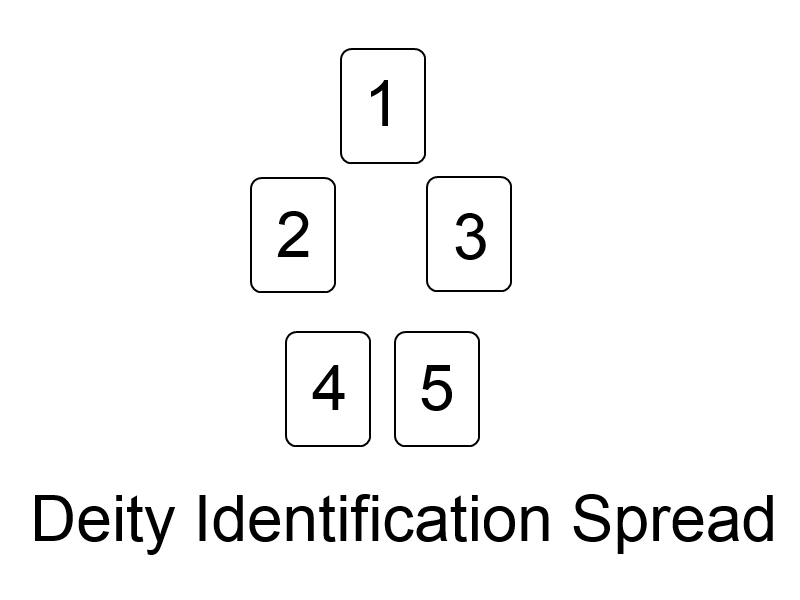
So, I made a spread to go with my Deity Communication Spread! You can use them together or separately or not at all!
Card One is the deity – this is the equivalent to the first card in the Deity Communication Spread.
Card Two is one of the qualities/traits associated with them. I tend to read this as a more “negative” trait. Something that might seem scary or intimidating.
Card Three is another personality trait, but this one is usually read as being seen as more positive.
Card Four is what this deity rules over, or has power over.
Card Five will be for something that the deity is associated with, like a symbol or animal or something. (In my first test I got a Queen court card and the Queen itself was the answer there)
These things can be pieced together to try to get a fuller picture of who it is you might be dealing with. If you’ve already used the Deity Communication Spread, you can take Card One from that reading and place it here – and if you haven’t, you can put Card One from this reading into the communication spread, once you’ve identified them and want to know what they want.
This one has been working out pretty well for me, so hopefully y’all will like it!
Easy Ways to Connect More Strongly with your Deities
- Say Good Morning when you wake up, say Good Night before you fall asleep
- Share your food with them. If you’ve ever wanted some of your friend’s french fries, you know how they probably feel.
- Donate to causes that fall under the jurisdiction of your deity. Are they a goddess for women? Donate to a women’s shelter or Planned Parenthood. Is your deity a patron of the arts? Give to PBS or local theatres.
- Cook a full meal in honor of your deity. Seriously. It sounds silly but you can definitely find a regional cookbook based on your pantheon to cook a full ass feast for them.
- Write them letters or notes. Keep a little notebook of notes and letters to your deity. Did you see a cute cat that you think Frigga would’ve liked? Maybe you saw a girl’s outfit that would’ve made Aphrodite drool. Let them know, or give yourself a reminder to tell them about it later.
- Change your phone background. Does your deity have a temple or built pantheon? Put that shit as your wallpaper! Did you find a picture that so perfectly captures the spirit of your deity? Make it your lock screen.
- Make them a Mix Tape. You know, so you can belt out songs in their honor while making your way downtown. Faces pass. And you’re home bound.
- DIY your Altar. I’m not going to lie, I’m not to altar type. However, it is a fantastically personalized space that you can do anything with. So don’t let anyone stop you from knitting that mini statue of Hecate a scarf.
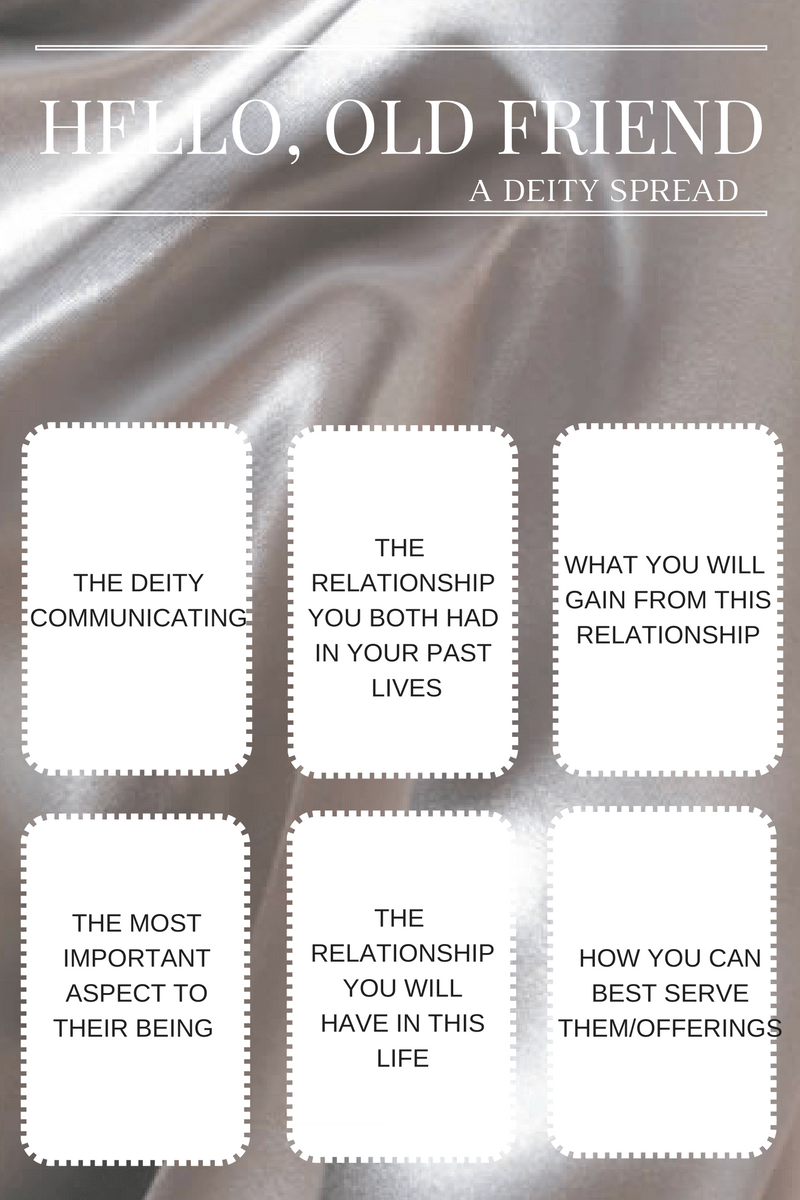
HELLO OLD FRIEND – A DEITY SPREAD
For understanding new or existing deities that have presented themselves in your life. It invokes an understanding that the relationship flows both ways, hence the focus not only on them but you. This can equally be used for spirit communication/angel communication/etc.
Crystals to use:
Amethyst
Clear Quartz
Black Tourmaline
Lapis Lazuli
**When contacting spirits/deities, please take the necessary precautions (cleanse the room, salt circles, ground yourself.) At ANY time where you feel like the reading is out of your control or that you are in danger, politely end the reading and cleanse your space once again. Be safe, know your limits, and don’t feel bad for politely declining a deity/spirit in which you feel like you can’t serve with where you are at this point in your life.
Celtic Gods and Goddess
The Celtic world included Ireland, Britain, and a large section of the mainland
Aine: Goddess of love and fertility; encouraged human love; has command over crops and animals; daughter of Eogabail
Amaethon: God of agriculture
Anu or Danu/Dana: Mother goddess
Aonghus: God of love; son of Dagda and Boann
Badb: Irish goddess of battle; could influence the outcome of conflict by inspiring fear or bravery in warriors
Balor: The one-eyed god of death, everyone he looked upon was destroyed
Belenus or Bel: Sun god; appears throughout the Celtic world in different forms; Beltaine celebrates him
Boann: Water goddess; mother of Aonghus
Brigantia: Chief goddess of Brigantes tribe; associated with water, war and healing
Brigid/Brigit: Goddess of healing and fertility; said to help women during labor; possibly same goddess as Brigantia
Camulos: God of war mostly worshiped in Belgium areas; said to wield an invincible sword
Ceridwen: Goddess of fertility
Cernunnos: God of wild animals, forest, and plenty; possibly also the god of death; known as the horned one
Cliodhna: Goddess of beauty; her three birds could sing the sick to sleep and heal them
Dagda: The great god; could restore the dead to life
Dian Cecht: God of healing
Don: Welsh version of Dana
Donn: God of the dead
Dylan: Sea god
Epona: Horse goddess
The Formorii: Sea gods; violent and misshapen
Goibhniu: Smith god
Lir: God of sea, healing and magic
Lugh: Sun god (Ireland)
Lugus: Sun god (France and Britain)
Mac Cecht: God of eloquence
Macha: One of the war goddess
Manannan Mac Lir: Sea god; could stir up or soothe the sea
Manawydan: Welsh sea god, extremely similar to Manannan
Morrigan/Morrigu: Goddess of death on the battlefield
Nechtan: Water god
Nemain: Goddess of war
Nemglan: Bird god
Nodens: God of healing; owned magic healing hounds
Ogma: God of eloquence; creating of Ogham, the oldest writing system in Ireland
Taranis: Name means thunderer; Romans equated him to Jupiter; symbol was the wheel
Teutates or Toutatis: Romans equated him to Mars
**Not all inclusive
All information gathered from “The Illustrated Encyclopedia of World Mythology by Arthur Cotterell and Rachel Storm
 fair--y backup