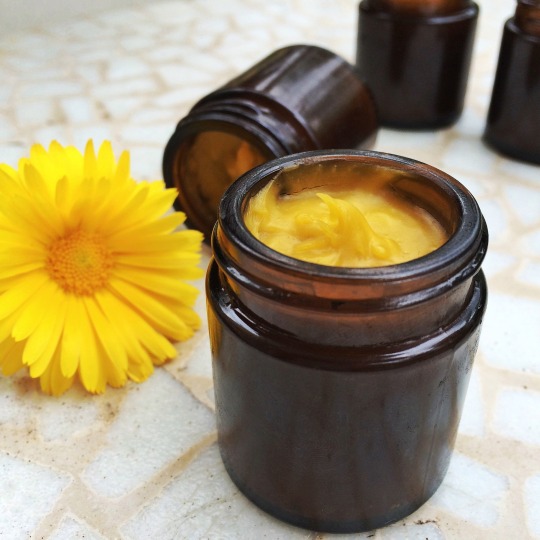
Salves are a simple yet effective way of applying the medicinal qualities of herbs. They’re the consistency of a cream at room temperature and portable for on-the-go topical application. By combining various herbal-infused oils, an individual can address a variety of ailments, from arthritis to asthma. Each salve can be customized to the individual to treat a specific illness or can be general all-heal tool in your first aid kit.
Base Ingredients
Herbal-infused Oils
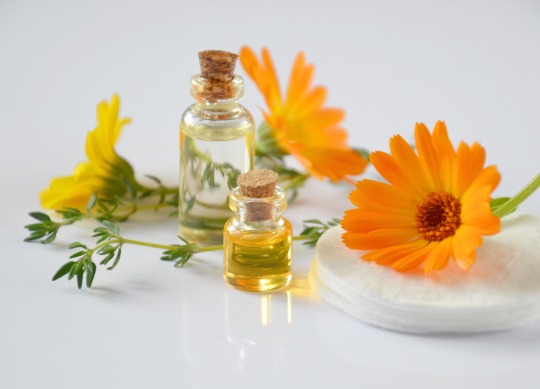
To craft a salve, you must start with herbal-infused oils as your primary base. For this, there are two components: your choice of herb(s) and your choice of carrier oil(s). Some commonly used carrier oils are olive, grapeseed, almond and safflower.
At the end of this post, there will be an overview of common herbs and carrier oils so that you can make an educated decision when crafting your herbal-infused oils.
Here are two basic methods of infusion:
Solar Method (Folk Method)
Take a sterilized jar and fill ⅓ to ½ of it with your choice of dried herbs.
Cover with your carrier oil. Add around 500 IUs of vitamin E oil for every 8 oz. of carrier oil to prolong shelf life.
Cap the jar tightly and place in a sunny space – either outdoors or indoors. Shake it daily.
Allow the mixture to infuse for 2 to 3 weeks, or until the oil takes on the colour or aroma of the herb within.
Once the oil is ready, strain using a cheesecloth and bottle into a tinted sterilized jar. Store in a cool, dark place.
Slow Cooker or Stove top (Fast Method)
Place your choice of dried herbs in your slow cooker or pot and cover with your carrier oil. Add around 500 IUs of vitamin E oil for every 8 oz. of carrier oil to prolong shelf life.
Gently heat the herbs on very low heat (100 – 140 degrees Fahrenheit) for 1 – 5 hours until the oil takes on the colour and scent of the herb. You can cook it for longer at 100 F if you would like.
Turn off heat and allow to cool. Once the oil is ready, strain using a cheesecloth and bottle into a tinted sterilized jar. Store in a cool, dark place.
Do not use fresh herbs when crafting herbal-infused oils. They contain moisture and promote the growth of mold, especially if infused via solar method.
Wax
Waxes are frequently used in making cosmetics, body care products and salves: they help to bind and emulsify ointments and lotions. They also function as a natural hydrating ingredient and alleviate itching for those with sensitive skin.
The most commonly-used wax for crafting salves is beeswax; however, vegans and those with allergies can utilize carnauba wax which is sourced from the leaves of a Brazilian palm tree.
Method
Once the herbal-infused oils are prepared, the process of making a salve only takes a few minutes. Here are the steps involved in the process:
On low to medium heat, warm the herbal-infused oil(s) in the top of a double boiler or in a small saucepan.
Add the wax. Once the wax has melted, remove from heat.
If any, stir in any additional ingredients of your choice, such as essential oils.
Pour into your designated container(s).
Recipes
Soothing lip salve
3 tbsp beeswax
3 tbsp aloe vera gel
2 tbsp oil of choice
8 drops essential oil of choice (optional)
Salve for minor scrapes, bites and burns
1 ½ cups comfrey-infused oil
1 ½ tbsp coconut oil
¼ cup (55g) beeswax
Healing salve
1 quart (1 litre) of oil infused with equal parts St. John’s wort, comfrey, peppermint and lavender
¼ cup (55g) beeswax
Salve for backaches
1 cup ginger- and peppermint-infused oil
2 tbsp (22g) beeswax
First aid salve
1 cup St. John’s wort-infused oil
2 tbsp (22g) beeswax
Salve for rheumatoid arthritis
1 cup ginger- and licorice root-infused oil
2 tbsp (22g) beeswax
Common Carrier Oils
Almond oil, sweet: A fantastic carrier oil that contains fatty acids and vitamins A and E. It’s an effective emollient for moisturizing both skin and hair and is easily absorbed by skin.
Argan oil: This is a staple in moisturizing skin and hair care products. Argan oil contains tocopherols, phenols, carotenes, squaline and fatty acids – it’s a truly luxurious oil.
Evening primrose oil: Prized for its health and cosmetic benefits.
Grapeseed oil: A common base for many creams and lotions – it’s the go-to carrier oil since it’s especially useful for skin types that do not absorb oils well and does not leave a greasy feeling.
Olive oil: The most commonly-used oil in cosmetics and hair care.
Safflower oil: A highly-moisturizing oil that soothes troubled skin.
Common Herbs for Health and Wellness
Aloe Vera: Excellent for treating burns, cuts and scrapes.
Arnica Montana: These flowers offer strong anti-inflammatory properties. (Do not use in open or bleeding wounds. Long-term use can cause skin irritation.)
Black Cohosh: Offers anti-inflammatory and pain-relieving benefits. (Do not use during pregnancy or breastfeeding. Can cause gastric discomfort in some individuals.)
Blue Vervain: Relaxes the nervous system and offers reliable pain relief for rheumatism, joint pain and neuralgia. (Do not use during pregnancy.)
Chamomile: Antibacterial, anti-inflammatory and antispasmodic. (Do not use if on blood thinners or if allergic to ragweed.)
Chickweed: Wonderful for making soothing poultices to treat rashes, skin irritations, minor burns and itching.
Comfrey: Alleviates pain and inflammation; works well on cuts, scrapes, insect bites, burns and rashes. (Do not use on children.)
Echinacea: Antibacterial, anti-fungal and antiviral. (Do not use if you have tuberculosis, HIV/AIDS, autoimmune diseases, lupus, rheumatoid arthritis or if you are allergic to ragweed.)
Ginkgo Biloba: Natural antihistamine, anti-inflammatory and great for treating allergies and asthma. (Do not use if you take monoamine oxidase inhibitors (MAOI), selective serotonin reuptake inhibitors (SSRI), or blood thinners.)
Goldenseal: Antiviral, antibacterial and excellent for dealing with minor cuts and wounds, sinus infections, respiratory congestion, sore throats and more! (Do not use if you are pregnant, breastfeeding or if you have high blood pressure.)
Mullein: Great for first-aid treatment of minor wounds, burns and insect bites.
Plantain: Antimicrobial, antihistamine and anti-inflammatory; great for treating wounds, insect bites and minor aches and pains.
Sage: An excellent remedy for colds and fevers, hot flashes, painful or heavy periods, rashes and sore throats.
St. John’s wort: A strong antiviral; treats arthritis, fibromyalgia, muscle aches and sciatica. (Do not use if you take monoamine oxidase inhibitors (MAOI) or selective serotonin reuptake inhibitors (SSRI).)
Witch Hazel: An effective remedy for acne, cuts and scrapes, insect bites, minor burns and sunburns.
–
Images are under the Creative Commons License.
Information published is from my personal grimoire and has been accumulated over the years through a variety of books and resources while residing in Croatia, Serbia, Bosnia, Cuba and Canada.
There’s a post going around here stating that Gods and Goddesses are not correspondences for spellwork and should not be used by magical people as such. That’s all well and good. But. As an animist, I would like to also add…
PLANTS ARE NOT CORRESPONDENCES EITHER.
Plants have spirits. They have personalities. They are capable of working a magic all their own.
If you want to understand the plants you use in your craft better, grow ‘em. Find ‘em in nature. If you can’t do either because they’re not part of your local biosphere, sit down with the dried pieces of plant matter or resin or whatever and commune with them.
Talk to your plants. Tell them what you want when you work with them. If you’re growing them, talk as you water them and tend to them.
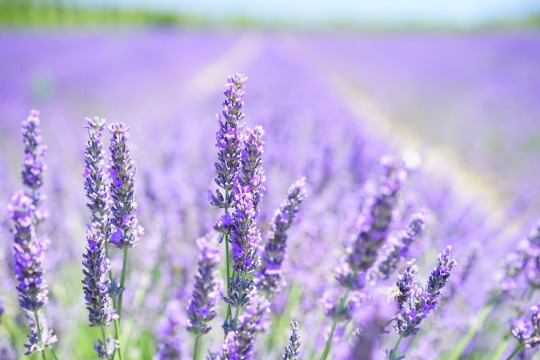
It’s one thing to be like, “oh yeah, rosemary is for protection and lavender is for love.” It’s another thing to understand why rosemary is for protection and why lavender is for love. Looking into old plant lore can help, but developing a one-on-one relationship with the plant is vital if you want to increase the quality of the plant-worker relationship.
A good starting point to help more with this concept (since to our modern minds it can be a bit difficult to understand, at least from my observation) is to read about Agrippa’s Doctrine of Signatures. Nature provides for us the medicinal and often occult virtues of many plants based on their outward appearance, which is an intensification of the inward spirit force. Sharp thorns say: Stay Away. Soft petals and an inviting scent say: Come to me. Some plants are tricksters and disguise themselves as other plants, like Hemlock disguising kiself with Queen Anne’s Lace.
Experimenting with how different materia reacts to certain conditions, such as being burned, powdered, made into teas, or oils can also help to learn more about them. Our ancestors ate, drank, smeared, stuck them up their asses to learn the virtues of the natural world (may they rest in peace), and then passed down that knowledge.
Of course, if you don’t want to take the time learn how to do all that (because it’s honestly a ton of work, and who has the type of time or resources to do that all the time?) reading up on that knowledge which has been passed down is totally valid.




 fair--y backup