Primordial gods continued: Children of Nyx (Night)
Moros (m) “doom, fate”. siblings Thanatos (peaceful death) and Ker (violent death and terminal illness). Roman: Fatum
Thanatos (m) “death.” minor deity. twin brother of Hypnos (sleep). siblings Geras (old age), Oizys (suffering), Moros (doom), Apate (deception), Momus (blame), Eris (strife), Nemesis (retribution) Charon (the boatman of Hades). Symbols: butterfly, poppies. Roman: Mors, Letum
Keres (f, plural. singular “Ker”). death spirits. daughters of Nyx and sisters of the Moirai. Dark beings with a thirst for human blood, hovering over the battlefield searching for dying men. Roman: Tenebrae
Geras (m), old age. Roman: Senectus
Oizys (f), mistery, anxiety, grief, depression. Twin of Momos. Roman: Miseria
Apate (f), deceit. companion of Pseudologoi (lies). Counterpart was Dolos (trickery); opposed Aletheia (truth). Roman: Fraus
Momus/Momos (m) satire and mockery. twin of Oizys (misery). Roman: Querella
Eris (f) “strife”. equated with war goddess Enyo. can be discord, or stirring up to action. Roman: Discordia
Nemesis/Rhamnousia/Rhamnusia/Adrasteia/Adrastia (f) the inescapable. Retribution against those who succumb to hubris. “To give what is due”. Mother of Helen. Roman: Invidia/Rhamnusia
Dolos/Dolus (m) “Deception”, trickery and guile, treachery. Apprentice of Prometheus. Roman: Mendacius
Eleos (m) pity, mercy, clemency, compassion. Roman: Clementia
Elpis (f), hope. Young woman carrying flowers or a cornucopia. Roman: Spes
Epiphron (m) “prudence, care” daimon/spirit of shrewdness, thoughtfulness, carefulness, sagacity
Hybris (f) insolence, violence, outrageous behavior (hubris). Roman: Petulantia
Philotes (f), spirit of affection, friendship, sex. associated with her sister Aphrodite/Kypris
Sophrosyne (f) ideal character, temperance, moderation, prudence, purity, decorum, self-control
Hypnos (m) “sleep” Roman: Somnus
The Oneiroi/Oneiri (m, plural). gods and demigods of dreams, nightmares, and dream symbols.
Lived in the land of dreams, Demos Oneiroi, part of the underworld. Oneiri:
- Morpheus (can take on the forms of men)
- Phobetor (can take on the forms of beasts)
- Phantasos (can take on the forms of inanimate objects)
- Phobetor/Iceus (m) “frightening”/”semblance” was also god of nightmares.
- Epiales/Epialos/Epioles/Epialtes/Melas Oneioi (black dreams): nightmares
- Phantasos (m) god of surreal dreams
Tag: hellenic
Hey can anyone recommend me some credible/good dodekatheist/Hellenic blogs? I woulddd like resources to start delving into it a bit.
Tyche
Anyone have any sources on Tyche?
*rolls in* Dodekatheism seems interesting but I’m afraid of joining what do I do
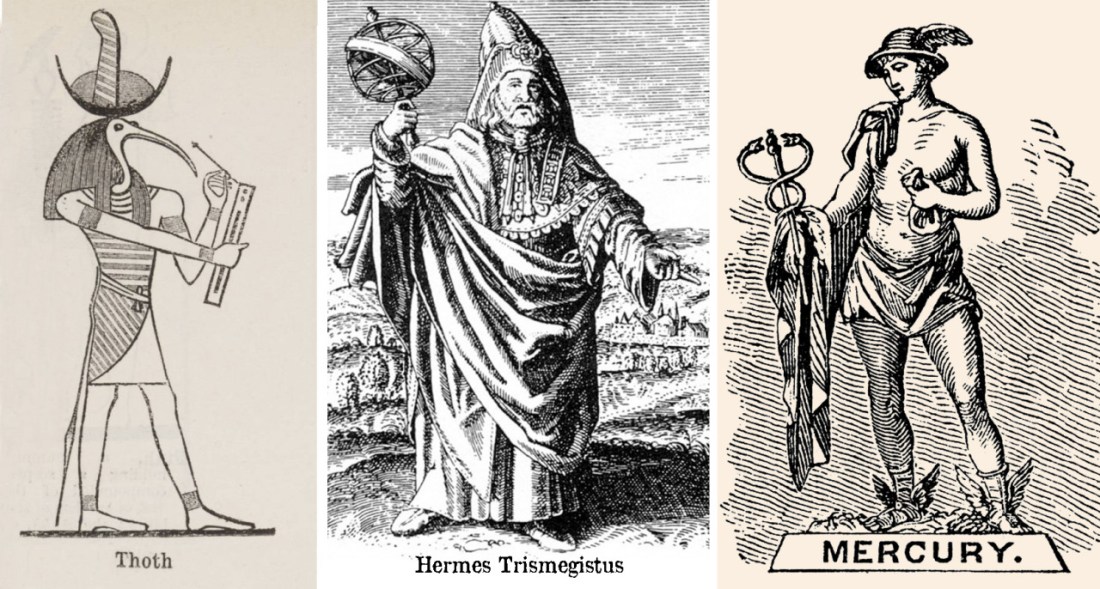
Hermes Trismegistus (Greek for “Hermes the thrice-greatest” or Mercurius ter Maximus in Latin, is the syncretism of the Greek god Hermes and the Egyptian Thoth. In Hellenistic Egypt, the god Hermes was given as epithet the Greek name of Thoth. He has also been identified with Enoch. Other similar syncretized gods include Serapis and Hermanubis.
Hermes Trismegistus might also be explained in Euhemerist fashion as a man who was the son of the god, and in the Kabbalistic tradition that was inherited by the Renaissance, it could be imagined that such a personage had been contemporary with Moses, communicating to a line of adepts a parallel wisdom. A historian, however, would leave such speculation to the history of alchemy and the nineteenth-century history of occultism.
Both Thoth and Hermes were gods of writing and of magic in their respective cultures. Thus the Greek god of interpretive communication was combined with the Egyptian god of wisdom as a patron of astrology and alchemy. In addition, both gods were psychopomps, guiding souls to the afterlife.
The majority of Greeks, and later Romans, did not accept Hermes Trismegistus in the place of Hermes. The two gods remained distinct from one another.
The Hermetic literature added to the Egyptian concerns with conjuring spirits and animating statues that inform the oldest texts, Hellenistic writings of Greco-Babylonian astrology and the newly developed practice of alchemy. In a parallel tradition, Hermetic philosophy rationalized and systematized religious cult practices and offered the adept a method of personal ascension from the constraints of physical being, which has led to confusion of Hermeticism with Gnosticism, which was developing contemporaneously Dan Merkur, “Stages of Ascension in Hermetic Rebirth”.
As a divine fountain of writing, Hermes Trismegistus was credited with tens of thousands of writings of high standing, reputed to be of immense antiquity. Plato’s Timaeus and Critias state that in the temple of Neith at Sais, there were secret halls containing historical records which had been kept for 9,000 years. Clement of Alexandria was under the impression that the Egyptians had forty-two sacred writings by Hermes, encapsulating all the training of Egyptian priests. Siegfried Morenz has suggested (Egyptian Religion) “The reference to Thoth’s authorship…is based on ancient tradition; the figure forty-two probably stems from the number of Egyptian nomes, and thus conveys the notion of completeness.” The Neo-Platonic writers took up Clement’s “forty-two essential texts”.
The so-called “Hermetic literature”, the Hermetica, is a category of papyri containing spells and induction procedures. In the dialogue called the Asclepius (after the Greek god of healing) the art of imprisoning the souls of demons or of angels in statues with the help of herbs, gems and odors, is described, such that the statue could speak and prophesy. In other papyri, there are other recipes for constructing such images and animating them, such as when images are to be fashioned hollow so as to enclose a magic name inscribed on gold leaf.
During the Middle Ages and the Renaissance, the writings attributed to Hermes Trismegistus known as Hermetica enjoyed great credit and were popular among alchemists. The “hermetic tradition” therefore refers to alchemy, magic, astrology and related subjects. The texts are usually distinguished in two categories the “philosophical” and “technical” hermetica. The former deals mainly with issues of philosophy, and the latter with magic, potions and alchemy. Among other things there are spells to magically protect objects, hence the origin of the term “Hermetically sealed”.
The classical scholar Isaac Casaubon in De Rebus sacris et ecclesiaticis exercitiones XVI (1614) showed, by the character of the Greek, the texts that were traditionally written at the dawn of time, to be more recent: most of the “philosophical” Corpus Hermeticum can be dated to around AD 300. However, flaws in this identification were uncovered by the 17th century scholar Ralph Cudworth, who argued that Casaubon’s allegation of forgery could only be applied to three of the seventeen treatises contained within the Corpus Hermeticum. Moreover, Cudworth noted Casaubon’s failure to acknowledge the codification of these treatises as a late formulation of a pre-existing (possibly oral) tradition. According to Cudworth, the text must be viewed as a terminus ad quem and not a quo.
Modern occultists continue to suggest that some of these texts may be of Pharaonic origin, and that “the forty two essential texts” that contained the core work of his religious beliefs and his life philosophy remain hidden away in a secret library.
Can someone on the Hellenic end of tumblr help me out real quick? I’m new to this and I’m not sure what the epithets/the words after the gods’ names mean
Epithets are specific titles that narrow down which aspect/role of the god you’re addressing. (Most of them. Some of them are poetic/obscure and we’re not sure what they mean exactly.) “Phoibos Apollon” means something like “Bright/Shining Apollon” and would be a way to address him as a god of light and the sun. “Apollon Paian” refers to “Apollon the Healer” or “Apollon the Deliverer” and would be a way to address him as a god of healing or savior.
There are also historical epithets that reference a place a god was worshipped or where a major temple stood (Hera Argeia – of Argos, Hera Samia – of Samos).
That’s a very brief overview that’s glossing over a lot of exceptions, but basically you can think of epithets as titles (as in, of nobility) that come from a variety of different sources.
My favorite explanation has always been –Barbie.
You have President Barbie, Flight Attendant Barbie, Doctor Barbie, Mommy Barbie. Each tells you something about her, her job, her role, and so forth. Sometimes she’s a mermaid, sometimes she roller blades.
So it is with the gods. Aphrodite is both Killer of Men and She of the great butt. You’re highlighting parts of her.
She of the Great Butt 😂😂😂
Miasma
Miasma is the impurity we as humans naturally accumulate and posses. It is not something we need to stress about getting away from us every moment of every day, and it is good to know that we will always be a little miasmic. However, miasma can be a bit of a challenge when it comes to worship and prayer.
Miasma translates to the vague word “pollution”, but it isn’t as bad as you might think. It’s just the everyday things we hold onto throughout our lives as humans. It is humanness, and nothing to ashamed of or scared of.
It can be very distracting, and I think of it as the force that pulls our focus and thoughts away from the Theoi. The essence of mortality, so to speak.
Although miasma isn’t bad, one of the pillars of Hellenismos is Hagneia, which is avoiding miasma for ritual purposes. Usually, people do this by Katharmos when they are doing a ritual, or something daily such as veiling. Khernips are seen as a cleqansing agent, and are used in the Katharmos ritual. (I will be writing a post on Khernips soon.)
Katharmos is done like so:
“The practice of katharmos historically starts with a bath (or
shower, in modern times). Step two is the preparation and use of
khernips (Χἐρνιψ). Khernips is created by dropping smoldering incense or
herb leaves into (fresh and/or salt) water (preferably sacred spring
water or sea water). When throwing in the lit item, one can utter
‘Xerniptosai’ (pronounced ‘zer-nip-TOS-aye-ee’) which translates as ‘Be
purified’. Both hands and face are washed with khernips. The vessel
holding the khernips is called a khernibeionas (Χερνῐβεῖον). For most
modern day Hellenics, washing themselves with khernips is step three,
seeing as they brush their teeth first, as the names of the Gods are
spoken through the mouth.”Source: Baring the Aegis

PAN
In ancient Greek religion and mythology, Pan is the god of the wild, shepherds and flocks, nature of mountain wilds, rustic music and impromptus, and companion of the nymphs. He has the hindquarters, legs, and horns of a goat, in the same manner as a faun or satyr. With his homeland in rustic Arcadia, he is also recognized as the god of fields, groves, wooded glens and often affiliated with sex; because of this, Pan is connected to fertility and the season of spring. The ancient Greeks also considered Pan to be the god of theatrical criticism. The word panic ultimately derives from the god’s name. In Roman religion and myth, Pan’s counterpart was Faunus, a nature god who was the father of Bona Dea, sometimes identified as Fauna; he was also closely associated with Sylvanus, due to their similar relationships with woodlands. In the 18th and 19th centuries, Pan became a significant figure in the Romantic movement of western Europe. X
*excited vibrating*
Hellenic Polytheism 101: Getting Started
I get the question a lot, of “Where do I start if I’m interested in Hellenic Polytheism?” and it can be a difficult question to answer. Sure, I link them to helpful posts, some good e-resources, and book lists, but that gives them a pile of info and doesn’t really tell them how to use it. So this is going to be me attempting to address the question of:
How do I get started in Hellenic Polytheism?
Modern Hellenic Polytheism is a lot of “build your own worship” with a few concepts that stay relatively stationary. So there is no one way to get started in
Hellenic Polytheism
. I’d say it’s important to gain an understanding of how worship and offerings work in Hellenic Polytheism though, as well as the “core concepts” that you can include in your worship at varying degrees of significance depending on what’s important to you.
If you don’t have specific theoi in mind that you’re interested in worshiping, then you can always “test the waters” with a few different ones, or even move through the theoi, learning about them and introducing yourself until you find someone that you’re really interested in. So, before we get into anything else, I’m going to link you to a post on introducing yourself to Hellenic deities. @Soloontherocks also has a post on basic Hellenic prayer that follows a similar formula. Related to the above, I also get a lot of questions about what you need for an altar or shrine, and here’s the link for that too.
So, now that you know how to set up a shrine or altar and introduce yourself, let’s talk about how Hellenic Polytheism differs from other religions, and take a look at the concepts in Hellenic Polytheism. baringtheaegis has an awesome page of Hellenic terminology that’s useful for this.
One concept of Hellenic Polytheism that I don’t talk about often is Arête, which is the concept of doing your best and reaching your full potential. It ties into Hellenic Polytheism when you start looking at how your actions and accomplishments can be seen as testaments to the theoi and using the gifts they’ve given you to your full abilities. This obviously deals with the concept that talents and skills we have are gifts from the theoi, and not everyone is going to involve arete in their practice.
There’s also Eusebia and
Kharis. Eusebia is the actual worship of the theoi, and maintaining piety. Kharis is the idea that we give to the theoi and honor them, simply as thanks for their existence and presence in our lives. We build a relationship with a theos through these two practices. I don’t talk about them a lot, and I rarely use the proper terms for them, instead talking about the concepts.
Another concept in Hellenic Polytheism is Miasma. Miasma is uncleanliness and a form of spiritual gunk that we get simply from being human. With Miasma comes Hagneia, or ritual cleanliness through the avoidance and cleansing of Miasma. I talk about several ways of cleansing and miasma in the post linked above.
The next concept I want to mention is Hubris. Now, if you’re not familiar with Hellenic Polytheism, you’re probably thinking that sounds like a very Abrahamic concept. Hubris in the Hellenic sense refers to putting yourself on the same level as the theoi. When Arachne claimed to be a better weaver than Athena by challenging the Goddess, that was hubris. Hubris is an offense to the theoi, and something that they will certainly let you know if you’ve done.
And the last one I’m going to talk about is Xenia, and by extension Theoxenia. Xenia is guest right. It’s the idea that you need to be a good host, to be kind to your guests and make them feel welcome. There is a flip side to that where guests have a responsibility to be polite and thankful of their hosts, not taking advantage of the host. Xenia is an important part of my practice, since by inviting the theoi into my home and life through worship, I’m basically asking them to be my guests for a short period of time, and that’s when Theoxenia comes into play. It’s an embarrassment, a dishonor, and can be taken as a personal slight if you treat your guests poorly.
My suggestion for anyone starting out in Hellenic Polytheism, is to figure out your own system based on the above concepts, and more that you may discover through research. Starting with eusebia is an easy and effective way to feel like you’re actually starting on your worship. I recommend picking one topic, concept, or idea in Hellenic Polytheism to learn about at a time. Pick one thing, learn about it, research it till you feel confident explaining it to someone else (even if you still have stuff you can learn on it), and then move on to another concept while trying to figure out how the previous one fits into your worship. This isn’t going to be the right way for everyone, and there’s plenty I didn’t mention in this, but I hope it helps a few people who are looking at Hellenic Polytheism.
 fair--y backup