So, I’ve come to find knowing how magic works for each individual can help immensely when it comes to studying and perfecting each person’s form of witchcraft. Everyone tends to be different, and finding out where you stand and how you personally use, store, and/or release energy can help when it comes to visualization. This can, in turn, greatly impact the success rate of each spell, working, or ritual a witch does. Obviously, it’s not an end-all, be-all. However, I’ve found knowing the information can help even just a tiny bit (or a lot, depending on the person.)
Internal vs External
The way energy moves throughout the body is a great way to start understanding how you can use and manipulate your own in your everyday life as well as in your practice. There are hundreds of different types of paths for energy to go, but for the most part, the two largest categories are: internal and external.
Internal
Internal energy pathways are self-explanatory. Typically, these people were born during the day and possess power from within their own bodies. They have a connection with the Sun. Internal is quite common, and these individuals may have to ground and cleanse themselves more than their counterparts. They can be gifted at enchantments, astral work, communing with deity or spirits, etc. Their cores emanate energy, which can be activated with a touch. Touch with the hands, feet, chest, and the top of the head would be ideal as these are their center points of energy. Internal magic users tend to rely on their instincts and intuition and often have extra-sensory abilities. My recommendation: focusing on visualization and using touch-based rituals/spells (sigils, baths, etc.)
Oil to help loosen up the internal energy flow:
Olive oil base
Sea Salt
Amethyst (chips or tumbled)
Rosemary (herb or oil form)
Yerba Santa, Sage, or Palo Santo
Burn either on a charcoal disk or rub on a candle to breathe it in.
External
External magic users are the lucky ones! Typically born at night, these are those lucky people who could wish for something and have it happen. They have an ability to influence the world from afar, like the Moon. They can trigger changes around them without thinking about it too much. Simply saying things like “I really wish I had some extra money,” might aid them in finding a spare $20 on the street. These are typically the people who can reblog emoji spells, and/or “money cat”-type posts and have a high success rate. Their bodies radiate energy and manipulating it may come naturally to them, to the point where they have no idea they’re doing it. They rely on their intellect and are disciplined, determined, and intelligent. They excel at area of effect rituals, such as wards. Energy manipulation, healing magic, and forms of divination may also be easier for them to master. My recommendation: learning how to manipulate their energy more and using repetitive mindset spells (ie, vision boards. AKA, wishing for something super hard.)
Oil to help loosen up the external energy flow:
Coconut oil
Lavender (herb or oil)
Sea Salt
Mint (herb or oil)
Selenite (Charge oil with it or add chips. Disclaimer: selenite dissolves in water, so either charge the oil or use pieces you don’t care for.)
Rub on skin, do NOT consume if you add selenite chips as it is unfit for internal consumption.
@witchfroot I applaud you for understanding, explaining, and sharing such a useful yet hidden phenomenon. I’m so happy to have learned from this! I’m just really excited when I can share/spread new eye-opening information like this ahh
Don’tlet yourself be pressured to define yourself or your path. Not now. Not ever. ( It is perfectly okay to have a type you do identify with or an identity, but it is also perfectly okay if you don’t know how to do more then describe your interests and what you are currently learning.)
When you consider yourself a witch, you are one.
That said, be prepared to experience some helpful hints if you’re being inappropriate (in an appropriation sense, or otherwise, being a danger to yourself or others).
Don’t be AFRAID of mistakes. Instead, make sure you learn your lessons that you can from the inevitable happening of them in your practice from time to time.
Be careful of what herbs, incense, candles and what ever else you burn, ingest, infuse, etc. (Some of these can be poisonous in certain uses, or cause miscarriages, skin allergies, etc. Make sure you read up on them, and know you’re body. Practice proper measures when consuming or using them. Know their properties. Know the side effects if something were to go wrong. This is for your own SAFETY and the safety of those around you.)
Practice, darn it. If you don’t use your newfound knowledge, you will not grow.
If you are low on energy, do simple things. Read up on your favorite new crystals, light a good smelling candle, take a herb infused bath, make a cup of tea, etc. Do things that will help you feel good and raise your energies.
Take breaks. Breathe. Go for a walk. Pet your favorite animal. Walk away from your studies for a bit. It’s okay to recharge. It’s healthy. You need to take care of your body and your mind, just as much as your spirit.
Don’t be ashamed if your interests change over time. That is okay too. It just means either you’ve found something new to be passionate about, perhaps your needs are different, and more.
ASK questions. PLEASE DO THIS. DO not let people scare you off from doing so. I encourage this so much. Yes, it may be discouraging to be told to research certain topics more, but sometimes, the other person can at least point you off in a direction they’ve experience with. Maybe give pointers or advice.
Most of all, if something feels uncomfortable, or wrong to you, stop for a moment and consider why. Did you do enough to ensure your safety? Did you practice it the way that feels good to you and goes with your intent? Did you miss a step when making that potion or working with drying herbs? Search for signs, check things, and it’s okay to be cautious.
When removing curses, banishing and undoing crystals are more powerful during the waning gibbous. This phase of the moon represents removing banishment and curses, unbinding, and cleansing.
After removing the curse, do an attraction spell during the waxing gibbous. This phase represents attraction, success, and good health.
So maybe you’re a college witch with limited space and money, limited to the one window in your dorm. Or, maybe you’re a witch without extensive backyard space who wants to start up a magical garden. Perhaps you’re a kitchen witch who wants the freshest herbs right at her fingertips.
For many witches, having a garden seems to be a bit of a no-brainer. After all, plants and magic go hand-in-hand. Plus, when thinking of a witch, it’s hard not to think of a cottage in the woods with a little vegetable garden out front. Unfortunately for the majority of us, our cottage in the woods is a tiny flat, and our garden out front is a windowsill with limited space.
This is when it comes time to embrace your craftiness and bring your garden indoors! Not only does it place your garden in a convenient location, it also allows you to freshen the air, recycle what would otherwise harm the earth, and embrace your witchy green thumb!
Eggshells for the Garden Witch
The kitchen witch has eggshells piling up on the counter, dried and ready to be ground up for use in protection powders. The garden witch looks at these shells and thinks, “Oh! Fertilizer!”
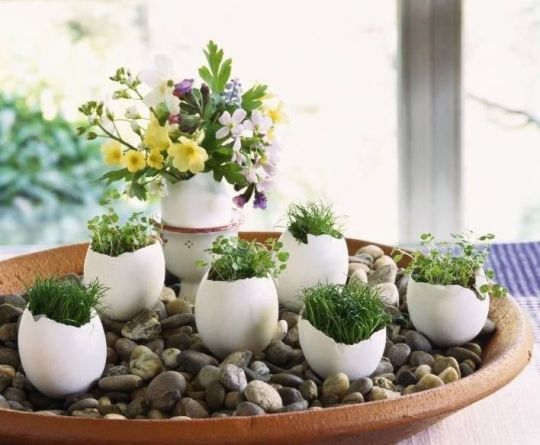
But if you’re limited in space and have to keep your garden limited to your windowsill, you may find yourself looking at those eggshells and saying “Oh! New pottery!” Not only is creating an eggshell planter a very green practice, but it’s also creative and makes transplanting much easier if you end up having a larger garden later on!
The Container…
Simple enough, you just need mostly intact eggshells. In the picture above, the eggshells are kept in the carton, but I’ve seen eggshells set up decoratively, such as with this picture:
The core of this post is clearly the eggshells, but you can arrange them in whatever way saves space or is aesthetically pleasing!
Carefully fill the emptied eggshell with potting soil. Make an indent in the soil with your finger, and carefully add your seedling before adding a final layer of soil and watering. If you plan on keeping the plants in the eggshells instead of transplanting, you could also carefully poke holes in the bottom of the eggshells so that your plants don’t get over-watered.
How Can I Witch This?
Eggshells alone are extremely protective, and providing your plants with that energy is beneficial. Around Ostara, use died eggshells! Not only will the shells have protective energy, but you’ll be able to use color correspondences and whatever symbols you used for the rite.
Draw symbols or runes of growth, protection, and strength on the shells in order to encourage your plant’s growth!
Bonus points is if you grow protective herbs in the eggshells!
May your harvests always be fruitful! Blessed Be! )O(
Here is a sneak preview of the project I’m going to be posting to this blog. It’s a book of portable altar spaces for my gods. I am a Hellenic polytheist and worship a LOT of deities, but I’m also a college student who moves frequently and has limited living space to devote to permanent altars. So this is my solution! The pages pictured here are works in progress, but I think their use is fairly self-explanatory.
I’m going to be putting together a more detailed instructional series of posts on how to make one of these books for yourself. But the guide will mostly be suggestions, feel free to personalize the project any way you want.
And while obviously my examples are going to be of Hellenic gods, this guide is totally open to followers of any religion that it might appeal to!
It’s summer! It’s the perfect time to gather flowers, herbs, and whatever else it may be you lovely witches use. This is okay except for the fact where it’s not, I’ve noticed a lot of you literally pick wildflowers, you pop off their heads. That’s not okay, if you don’t properly harvest a plant that’s an annual it may not bud next year, or may not bud again period this summer. How sad would that be? You can’t gain anything from a plant you kill and you owe it the plant to take from it in the least harmful way possible, it is giving you a portion of it’s life. An early disclaimer to avoid conflict, I am a botanist and master gardener and I’m completely qualified to give you this information.
Where To Start
We’re not getting straight into how to harvest, you need to take a minute to consider what you’re doing. Please don’t skip this, it’s important if you give a fuck about the Earth, if you do skip it you’re a dick. Unless you’re picking from your garden(or anywhere that isn’t wild), then you’re fine to skip this.
Are the plants your picking endangered? Have you bothered checking? I’ve seen a lot of witches post on here photos of plants that are going extinct. “Well, it’s just a daisy, there’s plenty of those!” Lakeside daisy are endangered and they’re beautiful, it would be a shame to lose them. There’s over 1,000 types of daisy’s and I can promise you many of them are endangered. Please look it up before you go out picking flowers, leave endangered or threaten species alone.
How do I know if it’s threatened? The majority of the time if you have a parks website you’ll be able to find a page that lists the wildflowers you’ll see on the trail and when they bloom. But what if I can’t find the information? Don’t pick the plant? You wouldn’t shoot an endangered animal, why would a flower be different? Flowers do not adapt like animals do, you can’t just introduce them to a new but similar ecosystem and expect them to exist happily, do not pick it.
Fear not though, there’s other ways to identify plants other than a metro-park website. There are always the information posts on trails and hikes, plus you can buy National Audubon’s Field Guide To Flowers!
Never take more than one-tenth of any given stand of plants, unless what you’re gathering is over growing as an invasive weed. The more you take the less likely it is to lively.
It is best to use gloves when picking and handling cut flowers. All parts of some flowers, such as monkshood, are poisonous and will give you hives and make you itchy, or just make you sick. It’s better to be safe than sorry. See this really helpful poisonous plants page for details
The Best Time To Harvest
For flowers and herbs gather in the morning soon after the sun has evaporated the dew away and before they have sat too long in the hot sun. Herbs and flowers are most potent before budding, and flowers naturally wilt a little when exposed to a hot sun(it doesn’t mean it’s unhealthy it’s just hot).
Most flowers are best picked when they are just starting to show color. Those in full bloom will go over more quickly. However, the flowers of some plants ,such as roses and dahlias, may not fully develop if picked in tight bud.
Roots should either be dug in the fall after the plant has seeded or in early spring just as new growth begins. They should be gathered early in the morning, and before the sun has been overhead too long. If the foliage of the plant has already begun to die, you can gather throughout the day.
Bark should be gathered in early spring, as this is when the sap starts to flow up from the roots, or in the fall, as the sap is returning to the roots. Never strip bark in a circle around a tree, as this will prevent the flow of nutrients from the roots to the branches and kill the tree.
Avoid gathering near roads (at least 50 feet), power lines, areas that may have been exposed to fertilizers, chemicals, pesticides or other insidious forms of chemical pollution. Plants growing around the foundations of old houses, especially those high in minerals, may take up any lead in the soil from old paint jobs.
IF YOU CAN’T CUT FLOWERS IN THE MORNING DO IT IN THE EVENING.
How To Harvest
Let’s be honest, there’s a lot of different ways to gather flowers and some plants need to gathered differently. I do not have the time or effort to list them all so I’m going to list the most common gardening tips.
Please don’t “pick” flowers or just tear them off the stem, you’re leaving them to die. I’ll fight you.
Always use clean, sharp utensils when cutting flowers. Knives, clippers, or shears can be employed. Please don’t ever use ordinary household scissors. The gauge on scissors is set for paper or fabric, not for flower stems, which are bulkier. Using scissors will crush their vascular systems and prevent proper water uptake. I recommend these.
Cut all flowers and foliage about one inch from the bottom of a main stem. Make the slice at an angle of about 45 degrees. Cutting at an angle provides a larger exposed area for the uptake of water.
Woody stems, like roses,
should have an additional vertical cut through the base of the stem to a length of about 2 inches.
Cut the stems to length with a clean, angled cut without leaving jagged edges that could lead to decay. Don’t hesitate when cutting, when you’re comfortable do one quick slice.
Gathering bark is much easier but you can usually find some on the ground if you look around a little bit. Use your knife at the top of a piece of bark and cut horizontally while moving your knife downwards. Trees are hella strong and won’t mind if you cut wrong or a little to deep but still – please be careful!
Substitutions in magick and spellwork is where you replace an ingredient for a spell with another due to lack of the listed ingredient. This is often done when a witch does not have specific plants, herbs or crystals on hand for when working a spell. This is a very common practice especially when individuals are on a budget or are still “in the forest” so unable to get specific ingredients. This is also done when a spell calls for an obscure or hard to find or even endangered herb/plant such as white sage, mugwort, nightshade, wormwood, wolfsbane and other harder to come by plants that one could not normally find in a store or local gardens.
General Substitution:
White Candles for any candle color
Rosemary for any herb/plant
Table Salt for any salt
Tap Water for any water
Clear Quartz for any crystal
Black Tea for any tea
Rose for any flower
Tobacco for any toxic herb/plant
Sage Incense for any incense
Olive Oil for any oil/carrier oil
Frankincense for any gum resin
Lemon for any citrus
Apple for any fruit
There are things in each “category” of ingredients for spells that are used for general over all substitution. Though these ingredients below can substitute for anything in their given category it does not mean that they are the best items to use for substitution in every spell. Why is that? Simply because each ingredient has different correspondences and though these items are “general” they have their own correspondences which can very much be different from what the spell is corresponding to.
An Example: Rosemary corresponds with protection, love, lust, mental powers, exorcism, purification, healing, sleep, youth. If you are using it in a spell for money it may not work as well as it would to substitute the missing herb with another herb that corresponds with money, wealth and prosperity. This is why the list above is simply for if you are in a pinch and you have absolutely nothing else to substitute in for it.
This is why it is better to go with intent based substitutions, for they tend to correspond better with the spell and are more likely to be successful. It is very easy to figure out other ingredients that work with a spell by seeing if the ingredient corresponds with the intent, such as does this crystal correspond with love in anyway? If so it is a good substitute for a love spell, if it doesn’t then it is a poor choice. This part is where you need to research yourself to ensure you are substituting things properly. Research the correspondences of what you have and see if they match with the spell you wish to find a substitute for.
Reworking
Reworking is the process of changing the actions, procedures and steps of a spell to cater to either one’s own situation or to work with ingredients that have been substituted or are missing. Reworking works hand and hand with substitution. The reason this is, is because sometimes when we substitute ingredients we can no longer use the same processes done in the spell. This is common when we substitute something such as a water safe crystal with a non-water safe crystal for a potion or substituting an edible plant with a toxic one in an edible spell.
Here is an example scenario that will show us both the process of standard substitution and reworking.
A Spell for Protection requires you to have a bowl of water and some aloe. The process of the spell is soaking the aloe in the water for a short time then rubbing the herb on your wrists and forehead. You wish to do this spell but you have come across the problem of having no aloe. Below are some examples of how to substitute with this spell and how to rework it when necessary.
Solution Example: You happen to have mint which also corresponds with protection. Mint is a non-toxic plant and it is good for your skin as well as smells quite nicely. So you easily replace the aloe leaves with mint leaves instead and go about the spell as the steps instructs. This is an example of substitution that does not require any sort of reworking.
Solution Example: You have blueberries which correspond with protection that you can use though you would rather not rub blueberries onto your skin leaving a sticky stained mess. This is where reworking is required. Blueberries are edible so instead you soak the blueberries in the water and instead eat the blueberries and then use the water to anoint yourself.
Solution Example: You have wolfsbane but it’s highly toxic and should definitely not be soaked in water, rubbed on your skin or ingested. This is a prime example of absolutely having to rework the spell for safety reasons. In this case it would perhaps be best to have the wolfsbane in a bowl and use its energy to mentally anoint yourself. This requires most likely reworking most if not all of the spell.
Reworking actions in witchcraft without substituting ingredients. This is most common due to a person’s situation or location making certain spells difficult to do. A very common example of this type of reworking would be reworking a spell to not have a burning process due to the witch being unable to use fire or burn objects due to their situation such as apartment or dorm living, lung sensitivity to smoke or having their own doubts about being able to work safely with fire due to one reason or another. Below are some suggested reworking actions for common things that some people are unable to do for one reason or another.
Substitutes for Burning: tearing/shredding, soaking in water (if safe), burying (if safe), pouring ink onto, scribbling out, erasing, crumpling or crushing, painting over, pouring wax over, cutting up via scissors, taping up
Substitutes for Ingestion: water soaking, meditation with item nearby, energy work via harnessing the item’s energy, burning (if safe), touch/holding (if safe)
Substitutes for Speaking/Chanting: thought/mental chanting, written word, gesture/sign language, listening to music with lyrics that correspond with spell/intent, air writing with finger
Reworking for Spoonies
Often spells can be too draining for those with “limited spoons” to use. In these cases, reworking a spell may often become necessary to make it easier on the witch casting it. In cases of this, certain gestures or steps may be too draining or difficult for the witch to perform due to physical or mental health. First off, this is nothing to be ashamed of, it’s okay if some things make you too uncomfortable or are just too difficult for you to do. There’s no reason to feel like you can’t do spellwork because of it. You can still do the spell by reworking the areas that you have difficulty in.
An example of this could be that a spell requires a lot of movement, gestures and chanting to do. As someone with limited energy you may not be able to exhaust so much of it by moving around like that. Instead you could examine the spell and see why that part may be required, if it is a spell to bring energy or motivation it may be added as a step to help encourage and invigorate the caster but making it difficult for you. Instead you can in this case find something that you find gives you a bit of a “pep in your step” that won’t exhaust you as much. An example may be music, listening to exhilarating and upbeat music can get the energy flowing instead so removing the chanting and dancing with loud energy filled music playing as you cast the spell is an excellent solution.
Another example may be that a witch has some lung and breathing difficulties making it very difficult for them to burn things or use incense due to it affecting their airways. In this case, the witch can examine what the spell is having them burn such as a spell for money having them burn basil and chamomile. Instead this witch can choose to soak the herbs into water or place them in a bowl near an open window to let the breeze spread their energy. Or even simply turning the spell into a sachet or jar spell instead of a burning one.
Personalization of Spells
To personalize a spell is to put your own personal touch onto it. This may include adding an additional step, adding ingredients or substituting ingredients not out of necessity but out of personal preference.
Examples of personalizing spells:
Adding the extra ingredient of rice to a money spell because you see rice as very closely related to money in your own personal practice
Adding a chant to a silent spell because you prefer chanting to get into the “witchy spirit” of the spell
Changing the spell’s written language because it is not your native one/you prefer using a different language for witchcraft
Changing the sigil in the spell to one of your personal sigils that you have a better association to the intent with
Replacing clear quartz with citrine for an energy spell because you prefer the energy of citrine over clear quartz
There are many ways to customize and personalize a spell to make it so it works better for you on a personal level. It is something that you will find easier to do with time once you have discovered the ingredients and methods of witchcraft that you prefer doing.
*note: reworking/personalizing a spell does not make it fully yours. If you wish to post this reworked/personalized spell please link it to the original or source the original seeing it was someone else’s work that you modified here and there for your own needs. It’s just polite to credit people for their work.
Sunny here, bringing you a crash course on one of the most critical parts of being a successful and safe spirit worker – discernment.
This was originally supposed to be a post on my spirit shop’s blog – but it closed unexpectedly. I have been requested to post this on my own blog, instead, since a lot of people liked it.
Humans have this peculiar habit of seeing what they want to see. You start looking for something, and suddenly you see the thing everywhere – it’s like when you buy a new car, never having recognized that car before, and suddenly it seems like every car on the road is the same model as yours. These ordinary things were there all along, but, now that you’re more aware of them, everything seems magical – and this is even more true when entering a new field of practice where things really are magical, like witchcraft and spirit work. This is why the key skill of discernment is so critical – to be able to separate the mundane from the otherworldly. When it is so easy to trick your brain into seeing the supernatural, how do you know when it’s really happening?
What’s that big word mean?
Discernment: the ability to evaluate information or situations to determine the underlying truth, the “real” from the “fake”, the “right” from the “wrong”. It is centered around an acuteness of judgment and understanding (x, x).
Okay, now you know what it technically means – you’ve got the dictionary definition under your belt. But why is this important for spirit work?
In the context of spirit work, discernment is used to define whether or not your experiences are “real”. It also plays a part in determining whether or not the spirits you are working with are safe or whether or not they are telling the truth. Discernment is also a critical component of vetting – verifying the identity of the spirit over the course of several months.
Though this may seem opposite to the entire point of discerning, I have personally found that strengthening my discernment skills has made it easier to notice when a spirit is attempting to interact with me. Since I have trained myself so heavily into seeking out all worldly explanations first, I have learned how to distinguish a spirit much more clearly – because sometimes there really is no worldly explanation for what happened. By teaching myself how to tell when my brain is just tricking me, I’m much more capable of determining what’s real.
This is something gained through practice and experience and is, in my opinion, a massively undervalued skill. It takes patience, practice, and time. So much time. This is why it can be so difficult to learn, and, more often than not, you end up learning the hard way why it is so important.
How can I tell if the “spirit” is just something ordinary?
Have you eaten enough? Have you had enough water to drink?
Did you take your medication, if you have any?
Did you get enough sleep?
Do you have any mental or physical illnesses or disorders? Does the “sign” you’re receiving from the spirit correspond to one of your symptoms? Do some personal evaluation!
Is there any physical explanation outside of yourself for the sign you have received? Ask questions like: Is the radio on in the other room? Is your neighbor outside mowing the lawn? Is this animal that I am “suddenly” seeing a lot of and interpreting as a sign actually just more active this time of year? Did someone just walk by wearing way too much perfume?
Do things happen when you think of them? If so, it’s possible you might be placebo-ing yourself into believing a spirit is causing this. Spirits act of their own accord.
If your answer to these questions after investigations was a firm “no” across the board, there could really be a spirit around. This is not a guaranteed way to tell, but the first step to spirit work is to remember that not everything is a spirit – sometimes it’s just your grandmother sneezing in the other room. You need to entirely rule out the mundane before assuming the supernatural.
Okay, I proved that it’s not something “normal” – but how do I learn how to sense and discern?
This is a difficult question to address, because sensing and discerning spirits varies so greatly from individual to individual. The only way to really tell if what you are experiencing is a spirit is through a lot of experience and trial-and-error.
Some simple pointers:
Investigate the “signs” you are receiving. Is there a pattern? If you ask for a specific sign (ex: “Show me three [animal that is not commonly seen in your area] in three days.”), does it show? Write everything down. Signs do not always appear within a few days – they could play out slowly, over a period of months, and you could miss them entirely.
Are you able to distinguish the difference between your own internal mental chatter and the voice of a spirit? This takes lots of time and practice, but it is a major component of spirit telepathy. Learn your own speech pattern and mannerisms – an actual spirit’s speech patterns and mannerisms are not likely to match up exactly to your own. Try this: listen to what a spirit is supposedly saying to you, and then attempt to repeat it exactly. Does it come out sounding garbled or feeling off? It might have legitimately been a spirit. If you are able to replicate their voice, tone, and words exactly, it may have just been your own brain trying to trick you.
Focus on learning how to differentiate energy signatures. A spirit may be able to change their physical appearance, but it is incredibly unlikely they will be able to change their entire energy signature – these are as unique as a fingerprint and equally as difficult to cover up. Check out this energy work FAQ, and read up on energy signatures – try out this worksheet, too. Here’s another post about how to read energy (and some expectations when you do it). Here’s some ways that energy can be sensed. Look up some exercises. Practice this as much as possible.
Attempt to communicate. This will also take lots of practice – keep going!
Use different methods of communication (telepathy, tarot, pendulum, scrying, astral travel, the list goes on…) to verify what the spirit is saying. One method is not enough. Cross-reference the spirit’s answers across the different methods used and see if everything lines up. If it does, you’ve got a real spirit on your hands. If everything seems jumbled and reads almost like gibberish, the spirit may not be present, but they also may not be communicating.
How do I determine if a spirit is telling the truth?
This is something that comes mainly through experience. No matter the species, energy alignment, or affiliation, spirits can and will lie to you.
Any spirit who is interested in working with you (or with any human) should be patient and understanding about the fact that you might have a little trouble believing if you are really hearing them – communicating to a physical being while you’re on a non-physical plane can be tricky, after all. If they really want to work with you, they’ll be willing to wait through the vetting and discernment process for you to properly detect them, get to know them, and determine if they are safe and honest about who they are and what they are capable of.
In addition, even if they are telling the truth, they may not have the best intentions. Evaluate what they want out of the working relationship. Does it make you uncomfortable? Does it seem realistic and achievable? Are they attempting to use you as a way to advance themselves or get out of a bad personal situation?
Educate yourself on manipulation tactics. There are a lot of techniques out there. Gaslighting is very common. People write and publish books on the art of influencing and manipulating people for all sorts of purposes. Social engineering and mindhacks are very real. The more educated you are on the techniques used, the more you’ll know what to watch for, and the more likely it is that you’ll avoid toxic people or groups.
If a spirit came to you and claimed that they’ve known you your entire life and had secretly been guarding and guiding you, would you believe them? Would you immediately trust a spirit who randomly appeared and started claiming to have been your best friend, partner, or mentor in a past life? The answer should be no – every single time, without fail. It’s very important to remember that spirits are not all-knowing, all-powerful beings. Do not trust blindly. Do not just “take [their] word for it”. Consider: why is the spirit coming to you, and why now? They could be telling the truth, but you do not want to rush things and assume. If they are truthful, they’ll be patient. Spirits could mislead you, and they could use your blind belief and trust in them to manipulate you. If a spirit shows up in your house and acts like you are destined to be friends and you enthusiastically accept their offer, you could be setting yourself up for much more danger than you know. Malicious spirits are not always outright malicious.
Take. Your. Time. Do not rush this. Jumping to conclusions and rushing the vetting process – which discernment is a major part of – can give a spirit the opportunity to trick you. It’s easy to put on a disguise and pretend to be someone else for a few weeks; it’s much harder to keep that act going for several months. When communicating with a spirit, it is also very important to avoid having a god or hero complex, thinking you will be the “best” for the spirit and by working with them you are “saving” them – and it’s important to not allow them to have that same mentality about you.
Doubt is healthy. Doubt can prevent a potentially traumatic spirit-related experience. Don’t be afraid to have a normal amount of doubt.
How does this apply to vetting and conjuring?
Are you a conjurer and/or a spirit companion shop owner? Great! This section is for you.
You, the conjurer, the shop owner – you are responsible for the safety of everyone who works through you, both human and spirit. This is very important to know before you even open your conjuring service. You need to be willing to put in the work – and this does not mean giving it the bare minimum. Your discernment skills need to be sharp, and your vetting needs to be intense. Any spirit who is truly willing to pursue companionship will be willing to go through this process – but you need to be insistent on making them go through the extent of it. If someone is meeting their future companion through your service, it is entirely on your end to do all of the discernment before they even leave you. Do not rush a spirit out – this could take months, or even years. It will be worth it. Take your time.
And the thing is, you shouldn’t be rushing spirits out. If you’re so impatient to throw up the listing of a spirit that you can’t fathom taking the time to get to know them for three months then I have to question how much you actually care. It might seem mean, but a shopkeeper should be willing to wait months and even years to match the spirit with the perfect person. By the time you post the listing of the spirit, you should be close friends with the spirit yourself. How else are you going to know what would truly be best for the spirit if you barely even know them past superficial friendships? And how else are you going to ensure that the spirit is safe if you barely took the time to get to know them?
[…]
But we also need to talk about an excuse that’s cropped up before in opposition to intensive vetting methods and that is how intensive vetting “hurts the spirit’s feelings”. If a spirit objects to undergoing a long vetting process then that should be taken as a red flag, not as you hurting their feelings. The intensive vetting is a necessity in assuring that the spirit is safe and when a spirit won’t agree to that then it’s easy to assume that the spirit wouldn’t be safe. Also, as mean as it sounds, the spirit’s feelings on whether or not they’re vetted shouldn’t matter. You have a responsibility to your customers to make sure that the spirit is fit for companionship, shirk that responsibility for any reason and you could very well be putting someone’s life in danger.
[…]
You are putting a spirit in someone’s inner wards, usually a beginner’s inner wards, and they’re someone who trusts you when you say that the spirit is safe. Don’t take advantage of someone’s trust in you just because you don’t want to put in the effort for an intensive vetting process when you chose to be a spirit shopkeeper.
(Read this post. Incorporate this into your practice. You should be settling for nothing less. If something happens that should have been discovered during the vetting process, it is your fault and is a sign that your process and practice has failed your client.)
Spirit work takes time. Vetting and discernment take a lot of time. If you are willing to learn and build a relationship with a spirit, and if you want to stay safe and avoid being someone’s lunch, you will need to be willing to put in the time and effort. Do not trust without questioning, even several months down the road of vetting. Take notes, and check everything the spirit says against those notes. Are there any discrepancies, or does their story just not make sense?
Leave no gaps. Take no shortcuts. By the time the vetting and discernment process ends, you should know the spirit well enough to call them a close friend.
Further Reading
Some of these are not specific to spirits, but these techniques, mindsets, and practices can also be applied to general spirit work.
This post is one of many out there about discernment. I heavily recommend, as I always do, to read more than just this post and the ones linked. I tried to branch out while researching, but I do have several favored blogs that I referenced – you should look for sources outside of these. My experiences, opinions, and views are not the only way that discernment is defined and my methods are not the only way to do it. Take everything I say and read further to form your own opinions. This post is not comprehensive and does not cover every possible method and definition of discernment. Remember, the posts linked above (and this post, too!) are people’s personal experiences and individual research, and, while there is major benefit to reading other people’s own original posts about the subject, you can never learn better than by learning on your own.
It’s not a secret that I’m not a rich witch. So if I can cut corners and get the same results, I will.
What you’ll need:
Toilet paper or paper towel roll
Tape
Wick or yarn
Wax (Soy, Palm, Bees, even Coconut oil or Shortening will work!)
Disposable Can or Jar
Flat Cookie Sheet
Saucepan
Water
Pencil
Alright first things first, getting your candle mold.
To the left is a paper towel roll, the right is the toilet paper roll. I personally prefer the paper towel roll cut in half; look how much more you get!
Next, get your tape and make a cross sticky side up like this
Stick your roll in the middle and smooth the tape flush against the sides. Now, take as much tape as you can and wrap it around the base with the rest of the tape. This step is SO important! If it’s not secure you get the mess I have below
Now secure your wick in the middle of the mold. Mine were pre tabbed so I had to tape them to the pencil to center them (Such a pain, by far my least fav part😒)
If you have yarn just tie it to the middle of the pencil, dip it as far as you can in wax, then place it in the middle of the mold like shown.
Now, get a saucepan filled a quarter of the water with water on the stove. Put it on simmer.
Place your can or jar in the saucepan (I used an olive jar thoroughly cleaned out.) Put in your wax little at a time to speed up the melting process.
Once melted, add in any color or scent and stir with a disposable utensil. (This is optional, if you want a simple white scentless candle then skip this step.)
Pour the wax in the mold carefully, hopefully it doesn’t leak.🤞
Let it sit for a few hours to cool. If you have a hole in the middle(I did) just pour more wax into it and let cool for another hour.
Cut at the top where the seam of the roll is here
Sometimes they stick and other times it will unravel right off the candle.




 fair--y backup
