Folk Names: Appleringie, Boy’s Love, Garde
Robe, Lad’s Love, Maid’s Ruin, Old Man. Gender: Masculine. Planet: Mercury. Element: Air.
Powers: Love, Lust, Protection.
Magical Uses: Southernwood is used in love spells, either carried or placed in the bedroom. Sometimes southernwood is placed
beneath the bed to rouse lust in its occupants. Burned as an incense southernwood
guards against trouble of all kinds, and the
smoke drives away snakes.
(from Cunningham’s Encyclopedia of Magical Herbs by Scott Cunningham)
Keeping a garden and/or some indoor plants is a great witchy practice, especially green and kitchen witches! However, to save yourself a lot of frustration and to make sure your green babies get the care they need, it’s important to research a few things before you plant:
Sun and shade requirements
Full sun means the area gets at least 6 hours of direct sunlight per day
Partial shade means the area gets 3-6 hours of direct sunlight, probably in the morning when it’s cooler.
Dappled shade means that the plant lives almost exclusively on indirect light: it gets a couple hours of cool light in the morning, and lives in filtered light like the kind through a forest canopy the rest of the time.
Figure out what the light conditions are where you want to plant, and make sure you plant things that can deal with that amount of light. Some plants find too much sun stressful and will dry out too fast, others will start to rot if they don’t have that direct sunlight to help them eat up their water.
Drought tolerance
If you live in an especially arid area, you will want almost exclusively drought-tolerant plants. If your area is more humid, then you’re going to water your drought-tolerant plants even less than one normally would. Research the aridity/humidity of your area, and adjust your plant’s watering accordingly.
Soil & Drainage
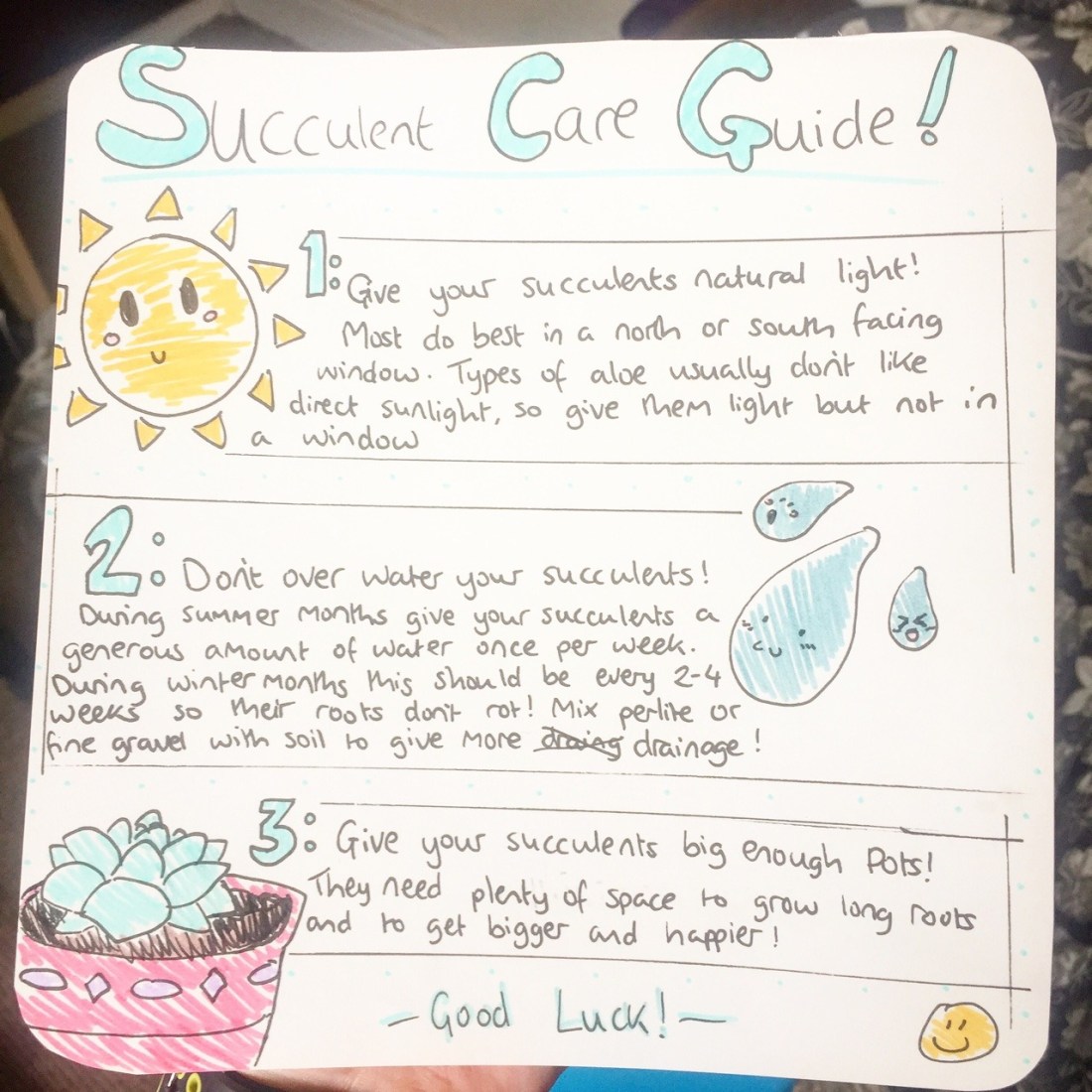
Not every plant actually wants a rich, dark, mulchy soil. Many cacti and succulents prefer soil that is mixed with sand and small stones to help it drain faster (too much water sticking around the roots can cause root rot), and plants that enjoy full sun and are drought tolerant tend to prefer well-drained containers that don’t hold on to water forever. Research your plant’s preferences and adjust their soil and drainage accordingly. More holes and stones or sand make things drain faster, less of both make them drain slower.
Depth & Distance
Some plants really need their elbow room, others need to be close together for support. Some do best when they can grow a big ol’ taproot that digs deep deep down into the groundwater, others are happy sticking near the surface. If you’re growing your plants in containers, research the root structures of your desired plants, and choose ones that can expand to a healthy rate in your containers and make sure new seedlings have enough distance from each other that their root systems don’t choke each other out. Your seed packet should have instructions on how far apart to plant.
Companion Planting
Many plants can benefit from being near each other: the pests common to one plant may be deterred by the smell or property of its close neighbour, one can attract pollinators for both, and so on. Research optimal companions for your desired plants.
Listed below are dangerous herbs and herbal combination and explanations as to why they are dangerous. Do not try any of these herbs, orally, on the skin, or in any other way ever (or during pregnancy or nursing, if listed as such).
*Some of the herbs mentioned are safe in small doses are are written as such. Other herbs are toxic in small doses or any amount. This is not a complete list.
Belladonna– Nightshade, bittersweet nightshade is an extremely poisonous herb and is absolutely deadly. It is related to Henbane. Side effects can include dry mouth, enlarged pupils, blurred vision, red dry skin, fever, fast heartbeat, inability to urinate or sweat, hallucinations, spasms, mental problems, convulsions, and coma.
Blue Cohosh – Can cause miscarriages, especially during early pregnancy. This herbs in combination with other herbs has been used as an aborfacient. It works by loosening and relaxing the uterine muscles. This is why it is often suggested as a remedy for pms and menopause.
Black Cohosh –
Can cause miscarriages, especially during early pregnancy. This herbs in combination with other herbs has been used as an aborfacient. It works by loosening and relaxing the uterine muscles. This is why it is often suggested as a remedy for pms and menopause.
Chaparral – This herb can cause serious liver damage, liver failure, and acute hepatitis.
Comfrey – Comfrey can be taken in small doses for upset stomach and pms, but using a lot is dangerous. Comfrey contains pyrrolizidine alkaloids, a type of poison that causes liver and kidney failure as well as cancer. They can be absorbed through the skin as well.
The amount of PAs found in comfrey changes according to the time of harvesting and the age of the plant. The roots have 10 times higher amounts of PAs than the leaves.
Devil’s Claw –
Harpagophytum, means “hook plant” in Greek. Devil’s claw causes additive effects in many medications. It can cause changes in blood pressure as well.
Eucalyptus – Eucalyptus can not be consumed. Taking 3.5 mL of undiluted oil can be fatal.Even applying too much to the skin and absorbing large amounts is dangerous. (Use it very lightly, dilute it, or use a humidifier.) Signs of eucalyptus poisoning might include stomach pain and burning, dizziness, muscle weakness, small eye pupils, feelings of suffocation, and some others. Eucalyptus changes how many medicines break down in the liver.
Foxglove – Poisoning by this herb can cause stomach upset, small eye pupils, blurred vision, strong slow pulse, nausea, vomiting, dizziness, excessive urination, fatigue, muscle weakness and tremors, stupor, confusion, convulsions, abnormal heartbeats, and death. Long-term use of foxglove can lead to symptoms of toxicity, including visual halos, yellow-green vision, and stomach upset.
Golden Seal – This herb is a uterotonic; brain damage (kernicterus) has developed in newborn infants exposed to goldenseal. Do not use goldenseal during pregnancy or breast-feeding.
Hemlock –
Neuromuscular
blockage can occur to the point of
death if it blocks the
respiratory muscles.
Henbane – Side effects include dry mouth, red skin, constipation, overheating, reduced sweating, vision disturbances, increased heart rate, urination problems, drowsiness, restlessness, hallucinations, delirium, manic episodes, and death. Henbane is poisonous and not safe for self-medication.
Kava – In the South Pacific, kava is a popular social drink, similar to alcohol in Western societies. It is used by some to treat anxiety, restlessness, and insomnia, but like many medicines used to treat these types of issues, Kava runs the risk of being too much of a ‘downer – oversedation.’ It can make you unable to operate machinery, fatigued, and worsen depression. Large doses can also effect the liver and cause yellowing of the eyes. Also, some of the dangerous chemicals in kava can pass into breast milk and might hurt a breast-fed infant. Avoid this herb if you have Parkinson’s disease or if you will undergo or have recently undergone anaesthesia as it effects the central nervous system.
Alcohol, sedatives, and benzodiazepines interact with downers.
Licorice Root – This tasty herb, when taken in high doses, may cause tiredness, absence of a menstrual period in women, headache, water and sodium retention, and decreased sexual interest and function in men. It may also cause early delivery in pregnant women and miscarriage in early pregnancy. This root has also been seen effecting hormone levels in the body and interacts with oestrogen. It also seems to rid the body or potassium. It can also cause heart failure.
Mistletoe (European) – Can cause chills vomiting, diarrhea, cramping, and other side effects. Short-term, frequent use of European mistletoe might cause liver damage. Lowers blood pressure.
Mugwort – This herb is dangerous in large quantities. Thujone, a ketone and a monoterpene that occurs naturally in two diastereomeric forms:-α-thujone and-β-thujone is present in wormwood Thujones cause a slight high and a feeling of relaxation, which is why it is enjoyed by smokers and drinkers (as a tincture or bitters), can also cause breakdown of muscle, nightmares, seizures, dizziness, confusion, numbness of arms and legs, paralysis, and death. The chemical is also said to be responsible for absinthe’s hallucinogenic effects.
Mugwort might cause a miscarriage because it can start menstruation and also cause the uterus to contract.
Pennyroyal – Pennyroyal has been used as an antificant and can also kill pregnant mothers. Do not use this herb as a method for miscarriage. It can cause irreversible damage to the liver and kidneys, nervous system, brain, and cam cause dizziness, confusion, seizures, and death.
Peony – Peony can cause uterine contractions and is unsafe to use during pregnancy. It also slows blood clotting.
St. John’s Wort – This herb interacts with SSRIs and other types of medications for the treatment of depression. In bipolar, bipolar depression, mania, manic depression, and other related disorders, St. John’s wort can trigger a major upswing or manic episode in patients. This herb also interacts with birth control.
Wormwood – Wormwood one of the main ingredients in the alcoholic beverage, Absinthe. The latin Absinthium comes from the ancient greek word apsínthion, which some claim translates to “Undrinkable”, referencing the herb’s extreme bitter flavor. It is closely related to mugwort, which is toxic in large doses, but wormwood is even more so. The herbs also contained thujones. See Mugwort.
Valerian – This herb, especially the root, can cause oversedation.
Alcohol, sedatives, and benzodiazepines interact with downers.
Valerian can cause some side effects such as headache, excitability, uneasiness, and even insomnia in some people. A few people feel sluggish in the morning after taking valerian, especially at higher doses. It’s best not to drive or operate dangerous machinery after taking valerian.
Wintergreen – This type of mint can be dangerous in high doses. Taking wintergreen oil or large amounts of wintergreen leaf can cause ringing in the ears, nausea, vomiting, diarrhoea, headache, stomach pain, and confusion.
So maybe you’re a college witch with limited space and money, limited to the one window in your dorm. Or, maybe you’re a witch without extensive backyard space who wants to start up a magical garden. Perhaps you’re a kitchen witch who wants the freshest herbs right at her fingertips.
For many witches, having a garden seems to be a bit of a no-brainer. After all, plants and magic go hand-in-hand. Plus, when thinking of a witch, it’s hard not to think of a cottage in the woods with a little vegetable garden out front. Unfortunately for the majority of us, our cottage in the woods is a tiny flat, and our garden out front is a windowsill with limited space.
This is when it comes time to embrace your craftiness and bring your garden indoors! Not only does it place your garden in a convenient location, it also allows you to freshen the air, recycle what would otherwise harm the earth, and embrace your witchy green thumb!
Eggshells for the Garden Witch
The kitchen witch has eggshells piling up on the counter, dried and ready to be ground up for use in protection powders. The garden witch looks at these shells and thinks, “Oh! Fertilizer!”
But if you’re limited in space and have to keep your garden limited to your windowsill, you may find yourself looking at those eggshells and saying “Oh! New pottery!” Not only is creating an eggshell planter a very green practice, but it’s also creative and makes transplanting much easier if you end up having a larger garden later on!
The Container…
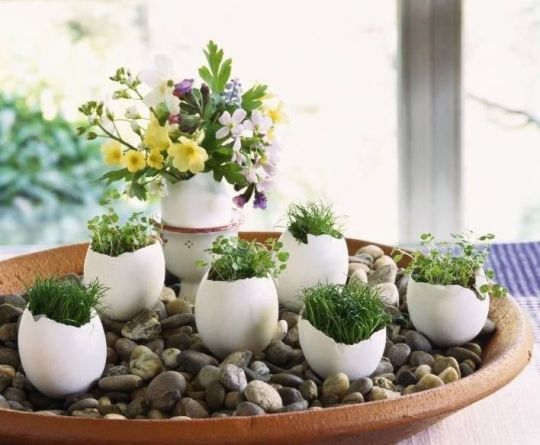
Simple enough, you just need mostly intact eggshells. In the picture above, the eggshells are kept in the carton, but I’ve seen eggshells set up decoratively, such as with this picture:
The core of this post is clearly the eggshells, but you can arrange them in whatever way saves space or is aesthetically pleasing!
Carefully fill the emptied eggshell with potting soil. Make an indent in the soil with your finger, and carefully add your seedling before adding a final layer of soil and watering. If you plan on keeping the plants in the eggshells instead of transplanting, you could also carefully poke holes in the bottom of the eggshells so that your plants don’t get over-watered.
How Can I Witch This?
Eggshells alone are extremely protective, and providing your plants with that energy is beneficial. Around Ostara, use died eggshells! Not only will the shells have protective energy, but you’ll be able to use color correspondences and whatever symbols you used for the rite.
Draw symbols or runes of growth, protection, and strength on the shells in order to encourage your plant’s growth!
Bonus points is if you grow protective herbs in the eggshells!
May your harvests always be fruitful! Blessed Be! )O(
Valuable information on individual herbs down below! 🌿
Posted: May 7th, 2018.
Updated: May 7th, 2018.
A
Acacia: Masculine. Deities; Astarte, Diana, Ishtar, Osiris, and Ra. Element; Air. Planet; Sun. Powers; Psychic Protection and Powers.
Agrimony: Masculine. Element; Air. Planet; Jupiter. Powers; Protection, banishes negative energy and spirits. Once used to detect the presence of witches.
Alfalfa: Feminine. Element; Earth. Planet; Venus. Powers; Prosperity and Fortune.
Clover: Masculine. Deity; Rowan. Element; Air. Planet; Mercury. Powers; Fortune, Luck, Success. TWO leaves; will soon find a lover. THREE leaves; can be worn as protection. FOUR leaves; strengthens psychic powers, leads the way to money. FIVE leaves: attracts money.
Coconut: Feminine. Element; Water. Planet; Moon. Powers; Purification and Protection.
Columbine: Feminine. Element; Water. Planet; Venus. Powers; Love and Courage.
Comfrey: Feminine. Element; Water. Planet; Saturn. Powers; Safety and Fortune.
Coriander: Masculine. Element; Fire. Planet; Mars. Powers; Health and Healing.
Corn: Feminine. Element; Earth. Planet; Venus. Powers; Luck and Divination.
Wormwood (TOXIC, do NOT ingest): Masculine. Deities; Artemis, Diana, and Iris. Element; Fire. Planet; Mars. Powers; Calling on Spirits, Divination, Love, and Psychic Powers.
Having knowledge of herbs and plants (either magically or medicinally) during the Middle Ages, often was reason enough to accuse a woman of being a “witch,” so there is no doubt some of the country folk at the time took these herbal folk names literal. Chances are, these names were used merely as descriptors to help remember them easier. Most plants were given
names descriptive of their uses and others were given names for something they
generally resembled. Spells written by witches in ancient times were often written with such descriptors, which personally i believe to be a form of secret coding.
Here is a small list of “witchy” herb names (most of these are already floating around the community) that you can use in your craft when you create your spells. This list could be a great addition to any Grimoire and i hope you find them as useful as i do.
Bad Man’s/Devil’s Oatmeal/Porridge – hemlock
Bad Man’s/Devil’s Plaything – Yarrow
Bastard – false Dittany
Bat flower – tacca
Bat’s Wing – Holly leaf
Bat’s Wool – moss (which moss?)
Bear’s Foot – Lady’s Mantle
Bear’s Grape Bearberry Arctostaphylos uva-ursi
Bear Paw – ramsons Allium ursinum or the root of male fern Dryopteris Felix-mas
Bear weed – Yerba Santa Eriodictyon californicum
Beard of a Monk – Chicory
Beggar’s Lice – Hound’s tongue
Beggar’s Buttons – Burdock
Bird’s Eye – Speedwell Veronica officinalis
Bird’s Foot – Fenugreek Trigonella foenum-graecum (Also bird’s foot violet and bird’s foot trefoil)
Bird’s Nest – carrot, Indian pipe
Bishop’s Wort, Bishop’s Elder – Wood betony Stachys betonica
Bitter Grass – Ague Root Aletris Farinosa
Black Sampson – Echinacea
Blazing Star – liatris
Blind Eyes – Poppy
Blood from a head – Lupine *
Blood from a shoulder – Bear’s breech *
Blood of a Goose – Sap from a mulberry * Morus nigra
Blood of an Eye – Tamarisk gall * (probably the tannin extracted from)
Blood of Ares – purslane *
Blood of Hephaestus – wormwood *
Blood of Hestia – Chamomile *
Blood – sap of the elder or bloodwort
Bloody butcher – Valerian
Bloody Fingers – Foxglove
Blue Bottle – Bachelor’s buttons
Boy’s Love, Lad’s Love: Southernwood
Brain Thief – Mandrake
Bone of an Ibis – buckthorn * I am not sure if this is Rhamnus cathartica or sea buckthorn Hippophae spp If I can find a recipe containing this, I will know for sure by comparing its purpose to their very different qualities
Bread and Cheese – Hawthorn
Bride of the Meadow – meadowsweet
Bull’s Blood – beet or horehound
Burning bush – false dittany, also a modern name for species of Euonymus
Cow’s Horn – Fenugreek Trigonella foenum-graecum
Bride of the Sun – calendula
Brown Dragon – wake robin
Buttons – tansy
Calf’s snout – Snapdragon
Candlemas Maiden – snowdrop
Candlewick – mullein, the flower stalk
Capon’s Tail – valerian
Carpenter’s Herb – bugleweed Lycopus europaeus
Carpenter’s Square – knotted figwort
Carpenter’s weed – Yarrow
Cat – catnip
Cat’s foot – white balsam, black cohosh, ground ivy
Cat’s herb – valerian
Chameleon star – bromeliad
Cheeses – marsh mallow
Chocolate flower – wild geranium (I don’t buy it)
Christ’s eye – wild clary Salvia verbenaca
Christ’s ladder – centaury
Christ’s spear – adder’s tongue fern Ophioglossum vulgatum
Church steeple – Agrimony
Clear eye – clary sage
Cleavers – bedstraw
Click – goosegrass
Clot – great mullien
Cocklebur – Agrimony
Cock’s comb – amaranth
Colt’s Tail – fleabane
Crane’s bill – wild geranium
Crow’s foot – wild geranium, or wood anemone bulbous buttercup (verified)
Crowdy kit – figwort
Cuckoo’s bread – common plantago
Cucumber tree – magnolia
Cuddy’s lungs – great mullein
Crown for a king – wormwood
Dagger flower – blue flag
Daphne – bay laurel
Dead man’s bells foxglove
Death angel – fly agaric Amanita Muscaria
Death cap – fly agaric Amanita Muscaria
Death flower – Yarrow
Death’s Herb – Belladonna
Delight of the Eye – rowan
Devil Plant – basil
Devil’s Apple – Mayapple or Mandrake
Devil’s beard – houseleek
Devil’s bit – false unicorn root
Devil’s cherries Belladonna berries
Devil’s plaything – yarrow
Devil’s dung – asafoetida
Devil’s ear – wakerobin
Devil’s eye – henbane or periwinkle
Devil’s flower – bachelor’s buttons
Devil’s fuge – mistletoe
Devil’s guts – dodder
Devil’s herb – belladonna
Devil’s milk – celandine
Devil’s nettle – yarrow
Devil’s Shoestring: Various varieties of vibernum, esp Black Haw, cramp bark, hobblebush
Dew of the Sea – Rosemary
Dog Berry – wild rose hips
Dog’s mouth – snap dragon
Dog’s tongue – hound’s tongue
Dove’s foot – wild geranium
Dragon – tarragon
Dragon Flower – blue flag (really, wild iris? not an arum or a Antirrhinum?)
Dragon wort – bistort
Dragon’s blood – calamus
Fairy smoke – Indian pipe
Fairy fingers – foxglove
Fat from a Head – spurge *
Felon herb – Mugwort
Five fingers – cinquefoil
Fox’s Clote – burdock
Frog’s foot – bulbous buttercup
From the belly – Earth-apple. * potato?? Did the writers know about potatoes? When was pgm written?
From the foot – houseleek *
From the loins – chamomile *
Hag’s taper – mullien stalk
Hagthorn – hawthorn
Hair of Venus – Maidenhair fern
Hairs of a Hamadryas Baboon: Dill Seed *
Hare’s beard – mullein
Hawk’s Heart, Old Woman – Wormwood Artemisia absinthium crown or seed head *
Hind’s tongue – hart’s tongue fern
Holy herb – yerba santa
Holy rope – hemp agrimony Eupatorium cannabinum
Horse tongue – hart’s tongue fern
Hundred eyes – periwinkle
Innocence – bluets
Jacob’s Staff – Great Mullein
Joy of the Mountain – Marjoram
Jupiter’s Staff – Great Mullein
King’s Crown: Black Haw vibernum
Knight’s Milfoil – Yarrow
Kronos’ Blood – sap of Cedar *
Lady’s glove – foxglove
Lamb’s ears – betony but more likely lamb’s ear Stachys byzantina
Lion’s Hair – The extra little roots that stick out of the turnip bulb or the base leaves Brassica rapa *
Lion’s tooth – dandelion
Little dragon – tarragon
Love in idleness – pansy
Love Lies Bleeding – amaranth (Not so ancient, a modern ornamental variant)
Love Leaves – burdock
Love man – goosegrass
Love Parsley – lovage
Love root – orris root
Maiden’s Ruin – Southernwood
Man’s Bile – Turnip Juice *
Man’s Health – Ginseng
Master of the Woods – Woodruff
May Lily – Lily of the Valley
May Rose – Black Haw viburnum
May – Black Haw viburnum
Maypops – Passion Flower
Mistress of the Night – Tuberose
Mutton Chops – Goosegrass
Nose Bleed – Yarrow
Old Man’s Flannel – Great Mullein
Old Man’s Pepper – Yarrow
Old-Maid’s-Nightcap – Wild Geranium
Queen of the Meadow Root – Gravelroot
Queen of the Meadow – Meadowsweet
Queen of the Night – Vanilla Cactus
Rats and Mice – Hound’s tongue
Ram’s horn – valerian
Ring a Bells – bluebell
Robin run in the grass – goosegrass
Scaldhead – blackberry
Seed of Horus – horehound
See bright – Clary sage
Semen of Ammon – Houseleek *
Semen of Ares – Clover *
Semen of Helios – White Hellebore *
Semen of Hephaistos – Fleabane *
Semen of Herakles – arugula *
Semen of Hermes – Dill *
Seven Year’s Love Yarrow
Shameface – Wild Geranium
Shepherd’s Heart – Shepherd’s Purse
Silver Bells – Black Haw viburnum
Snake Root – black cohosh
Soapwort – Comfrey or Daisy or maybe Soapwort
Sorcerer’s Violet – Periwinkle
Sparrow’s Tongue – Knotweed
St. John’s Herb – Hemp Agrimony
St. John’s Plant – Mugwort
Star Flower – Borage
Star of the Earth – Avens
Starweed – Chickweed
Sweethearts – Goosegrass
Swine’s Snout – Dandelion leaves
Tail of a Pig – Leopard’s bane *
Tanner’s bark – toadflax
Tartar root – ginseng
Tears of a Hamadryas Baboon – Dill Juice *
Thousand weed – yarrow
Thunder plant – houseleek
Titan’s Blood – Wild Lettuce Lactuca virosa *
Torches – mullein flower stalk
Unicorn’s horn – unicorn root or false unicorn root
Urine – dandelion or maybe urine
Wax dolls – fumitory
Weasel – rue
Weasel snout – yellow archangel
Winter wood – wild cinnamon Canella alba
White – ox eye daisy
Witch’s Asprin – white willow bark (this is ancient?)
Witch’s brier – wild brier rose hips
Wolf claw – club moss
Wolf’s foot – bugleweed
Wolf’s milk – euphorbia
Woodpecker – herbLpeony
Worm fern- male fern Dryopteris Felix-mas
Yerba Santa Maria – epazote
Plant Parts/Body Parts
Blood – Sap or juice
Eye – The disc of a composite flower, or a seed
Foot – Leaf
Guts – Roots, stalks, tangly bits
Hair – Very stringy roots (sometimes silk or tangly stems)
Head – Flower head or seed head
Tail – Stem
Tongue – Petal, sometimes stigma
Toes – leaf or bud
Paw – sometimes bud, usually leaf
Privates – Seed pod
Worm – stringy roots
Wool – Moss
Minerals
A Snake’s Ball of Thread – soapstone *
Blood of a Snake – hematite *
Crocodile Dung – Soil from Ethiopia *
A Physician’s bone – sandstone *
Animal Parts
A Snake’s Head – A leech *
Blood of a Hyrax – A rock badger, * small weasel-like/rodent-like (but
actually neither) creature native to Africa and the Middle East
Blood of a Hamadryas Baboon – Blood of a spotted gecko *
Bull’s semen – the egg of a blister beetle *
Lion Semen – Human semen *
Kronos’ Spice – Pig Milk *
* From Ecloga ex Papyris Magicis: Liber I, V, xxvi
More Sources for verification –
Galen – De succedaneis, Claudii Galeni Opera Omnia, v 19
Paulus Aegineta, Corpus Medicorum Graecorum IX/2 vII


 fair--y backup