This list has been updated over the years and will continued to be updated over time. If you re-post this elsewhere, kindly credit me because it’s taken a long time to compile what I feel are useful resources on the following topics. The very basics are covered in my FAQ.
The Spiral Dance by Starhawk (most recent edition only, old editions have inaccurate info that has since been updated)
Elements of Ritual: Air, Fire, Water & Earth in the Wiccan Circle by Deborah Lipp
Wicca: A Guide for the Solitary Practitioner and Living Wicca: A Further Guide for the Solitary Practitioner (Scott Cunningham) – note that this book is somewhat outdated, due to it being written in the 1980s.
Witchcraft (non-Wiccan):
The Element Encyclopedia of Witchcraft by Judika Illes
Encyclopedia of 5,000 Spells by Judika Illes
Crone’s Book of Charms & Spells by Valerie Worth
Witchcraft: a History by P.G. Maxwell-Stuart
Mrs. B’s Guide to Household Witchery by Kris Bradley
Candle Magic for Beginners by Richard Webster
Master Book of Candle Burning by Henry Gamache
A Grimoire for Modern Cunningfolk by Peter Paddon
Traditional Witchcraft: A Cornish Book of Ways by Gemma Gary and Jane Cox
Notes: please take care before using herbs for medicinal and/or supplemental purposes. Many herbs are toxic (some authors fail to mention this!) and/or have harmful side-effects. Always do research and consult a professional before use.
approach Llewellyn-published books with caution — there are some great ones, but many aren’t well researched and may contain misinformation.
if all else fails, Google the author and ask around to see what people have to say about them – many bad authors have entire pages or discussions dedicated on why to avoid them!
always fact check information (especially if it involves ingesting anything or putting anything on the skin — just because an ingredient is natural does not mean it isn’t harmful/toxic)
Graveyard Wanderers by Dr Tom Johnson, an exploration of necromantic spells and rituals in the Swedish tradition.
Trolldom by Johannes Gårdbäck, a book of spells (very well organized, in my opinion) in the Scandinavian tradition of Trolldom.
Encyclopedia of 5,000 Spells by Judika Illes is, of course, a classic.
Carmina Gadelica by Alexander Carmichael is a book of Scots Gaelic spells and prayers and blessings.
Mastering Witchcraft by Paul Huson is technically a book of spells and rituals.
The grimoires are much the same. Grimoire.org is a great online resource as a quick reference guide.
Witches’ Potions and Spells by Katheryn Paulsen is a quite literal list of spells. Caution should be taken, as many of them contain poisonous ingredients.
So, I asked if there was anything not often covered in witchy information posts and @hopeforenvy suggested Spirit Work. Spirit Work fascinates me and I’m interested in learning more, but I don’t think I know enough about it to write my own post just yet, so I’m going to make a masterpost and include informational posts, spells, and sigils about and having to do with Spirit work. I found all of these by going through @sylvaetria ‘s Spirit Work tag, but I’m linking to the original post when I can in case this actually gets attention so that sylvaetria doesn’t get spammed with notifications.
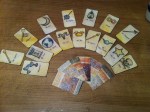
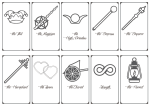
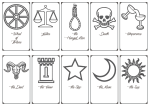
made a tarot card deck! I’ve been wanting to get a decent deck for the longest time, only to remember I don’t have the money to replace the deck I lost a while ago. So I made some of my of my own. And you can do to! The link above will bring you to my Deviantart page where you can download the printable PDF file. ⭐ Happy fortune telling ⭐ (Feel free to spread around)
For any of our witch fam struggling with money for a tarot deck! Download this one 😀 Or take the idea and make your own. You absolutely do not have to buy (or be gifted) your first deck! ❤
Ok, kiddies. Several of you have seen my post about the various resources and books I have in my Pagan/Witchcraft/Magick library and have asked “Where can I download the PDFs from?”
Well, now that things have calmed down a bit…Here it is! This post will always be growing as I find more PDF books. I did my best to organize them according to category.
Happy reading, loves 🙂
PS- Please message me if links are wrong or broken!
Please note that this guide is designed for spirit workers who already are capable of warding and sensing spirits. If you don’t know how to ward your space, or how to tell if it’s the wind howling or a spirit trying to get your attention, you should not be conjuring.
Before you even get started with any conjuring – have a purpose. In the beginning, it is very helpful to have a clear game-plan of what you want to do. Do you want to learn a new skill? Ask questions to a member of a species you’re very interested about? Consider this and write it down.
Take notes. Write as thorough a document as you are able to – spare no detail on the type of thing you are hoping to accomplish with your conjure. The more you write, the easier the rest of your conjure will be.
Additionally, research some banishing methods (I have included a few helpful links at the end of this post!), and prepare an offering. Please note that the offering you provide should be of equal value to the thing you are asking for. For example, if you are conjuring an entity because you want them to empower a spell, the offering you provide should be of higher value than if you are calling a spirit just to ask about their day.
MATERIALS:
Offering
Banishment spell and ingredients (if you need them)
Wards
Divination method (you can use telepathy if this is your strong suit, but having a divination method is incredibly helpful to confirm your answers and should be used as another method to verify answers during your vetting sessions)
Cleansing spell and ingredients (if you need them)
A quiet place, free of interruptions
Your written document
STEP ONE:
Make sure you have all of your materials ready. If you are going to need to banish something, you don’t want to have to pause your ritual and run to the kitchen for salt. Make sure your divination tools and your space have both been cleansed, and that you will have at least an hour of uninterrupted time.
STEP TWO:
Please, for god’s sake – make sure your space is well-warded.
Example of a bad ward: “Only light spirits with good intentions can come in.”
Why is it a bad ward? A spirit can be light aligned, or have good intentions, and still cause you harm. Consider a light-aligned angel who sees you as “unclean”, enters your wards, and attacks you to cleanse you. According to your wards, this would be acceptable. After all, he is light aligned AND he means well.
Examples of good wards: Wards that prevent spirits from using glamours while inside them, wards that prevent malicious or dangerous parasitic entities from entering, etc. Please make sure that when creating these wards, you are clear about your definitions of ambiguous terms, such as “dangerous” or “harmful”.
STEP THREE:
With your offering in hand, state your intent (this is where having the detailed document really comes in handy!). While being fancy and poetic can really get you in the Conjuring Mood, it’s best to aim for being clear. Saying something along the lines of “I am sending out a calling for ______, I offer ________ in exchange for _______” can be a good place to start.
STEP FOUR:
Wait for the spirit to show up. Once they are with you, confirm that they are not malicious. Make sure that they agree to the terms you specify. Some points you might want to consider including are:
They will only remain in your space for the duration of the conjure, and they will leave your space and have their permission to access it revoked once the conjure is completed
They agree to the transaction you proposed.
They will not lie, either explicitly or by omission, and they will present the information they provide in a way that does not misrepresent facts, lead to misinterpretations, etc.
The conjuring session is initiated once they agree to the terms you have set out, and it is finished when you say the following “____”.
If they agree to the terms, then proceed with the conjure. If they do not agree with them, ask them to leave and try again. If they refuse to leave, proceed to banish, cleanse, and put new wards in place.
STEP FIVE:
Begin the interaction with the spirit. While I encourage you to be polite and respectful, avoid language that might place you in a position of “debt” with the strange spirit (no “sorry”, “thank you”, etc.).
Listen to them, but also be on the lookout for anything that feels “off”. If you get a bad feeling- trust your gut. If you catch them in a lie, if their story doesn’t add up, if they are trying to convince you to sell your soul for riches – ask them to leave. If they do not respect your wishes, then banish them.
Some things you should look out for when interacting with a spirit are:
Claims about them being “totally your guide”, or “have been protecting you since you were a child, because your future is so special.”
“I am your long lost ____, and in your past life we were soulbound, I swear.”
“Only with my help will you be able to unlock your truest potential.”
While they might be sincere, it is important to keep a healthy level of cynicism in your interactions with a spirit. After all, they are a stranger, and while you might have met your soulmate during a random call into the astral, it is also very likely you just met an asshole. Just… make sure to keep that in mind.
STEP SIX:
Once you are done with the conjure, ask the spirit to leave. If things have been going well, you can schedule another meeting with them. Make sure they leave after you ask them to. If they don’t, then BANISH them. This may seem like an extreme measure, but they should respect your wishes. If they don’t, it’s unlikely they will for other things, too. Either way, once the spirit is gone from your space, make sure to dispose of your offering, cleanse your space, and thoroughly check your wards to see if they need any work.
Hidden like Viking gold under the landscape there is a rich body of nearly lost folkwitch tradition hiding in plain sight on the internet. Particularly in the 18th and 19th century antiquarians, folklorists and ethnologists documented the rural and occasionally urban folk beliefs of practically all of the UK and much of Europe. Organizations like the Folklore Society, founded in 1878, were created to help catalog and publish this body of collected ethnological data. A vast repository of a spectrum of witch and cunning craft practices.
Below are a list of links to various sources on the internet. The non Abramhamic roots of British folk traditions date from an era of Celtic settlers, and thus much of the spirit tradition concerns beings we now collectively call “fairies”, though their origins and nature differ greatly.
Books Available Online for free:
Folklore Society/Folk-Lore Journal:
Over 100 publications made by the Folk-Lore Society can be found on Archive.org. Unfortunately these are mostly unsorted, although they represent a massive amount of folkwitch information. Particularly in the realm of curses, hexes, salves, second sight, and boundary magic.
I will be launching a separate blog dedicated to delving into the contents of the Folklore Society’s publications in the next few weeks. In the meantime – Happy digging: Link to archive of FOLKLORE JOURNAL
Books whose content focuses on first-hand accounts of folk traditions, alpha by author. (* denotes particularly important titles)
Benjamin Thorpe
-Northern Mythology, Comprising the Principal Popular Traditions and Superstitions of Scandinavia, North Germany, and the Netherlands Volume 1 Volume 2 Volume 3
Lady Wilde
– Ancient Legends, Mystic Charms, and Superstitions of Ireland * Volume 1 Volume 2 Volume 3
Hi, Nonny. Wicca is an entirely different religion from Heathenry, with a different ritual format and, at least for reconstructionists, a different ritual calendar. It’s also totally acceptable to hold a blót on a day that isn’t an established holiday.
You can find posts about how modern Heathens structure their rites here, here, here, and here.
Also, I’m assuming it was a typo, but just in case: Sabbath is a Christian/Jewish thing (I can’t remember which though, or if both religions partake in it). The pagan term you’re looking for is “sabbat.”
I’m not a Heimdallr devotee and haven’t gone to nearly the same extent to research him as I have, e.g., Loki and Odin. But I can toss out some of the stuff I’ve run into over the years and point you to people who almost definitely know more than me.
Again, I am not pretending to have done all that much research in this area, so I encourage others to add resources!
– Mod E
Sharing for my own reference mostly.
I have nothing to add except all I have up for Heimdall is a Funko of him from the first Thor movie, sitting on a mirrored wall plaque that has a plant box on it. Behind the plant box is a carved tree with a mirror behind it, kinda representing the world tree. It’s mounted directly across the room from the front door.
Ancient Egypt was an ancient civilization of Northeastern Africa, concentrated along the lower reaches of the Nile River in what is now the modern country of Egypt. Egyptian civilization coalesced around 3150 BC (according to conventional Egyptian chronology) with the political unification of Upper and Lower Egypt under the first pharaoh. The history of ancient Egypt occurred in a series of stable Kingdoms, separated by periods of relative instability known as Intermediate Periods: the Old Kingdom of the Early Bronze Age, the Middle Kingdom of the Middle Bronze Age and the New Kingdom of the Late Bronze Age. [1]


 fair--y backup