I WOULD PAY TEN TIMES AS MUCH FOR CHOCOLATE IF IT MEANT REDUCING THE AMOUNT OF SLAVES IN THE WORLD? HOW IS THIS ANY KIND OF PROBLEM.
good news, you can! the company’s called Tony’s Chocolonely and their entire purpose is to make slave-free chocolate and reform the chocolate industry.
Whole Foods carries it. If you don’t want to support an Amazon-owned company, World Market carries it. You can also buy it directly from the company.
It’s the best chocolate I’ve ever had and it’s 100% slave free. Tony’s Chocolonely works really hard to push for transparency within the chocolate industry and actually has and is following an action plan to eliminate slavery within cocoa production. They’re good people who make good chocolate.
Having knowledge of herbs and plants (either magically or medicinally) during the Middle Ages, often was reason enough to accuse a woman of being a “witch,” so there is no doubt some of the country folk at the time took these herbal folk names literal. Chances are, these names were used merely as descriptors to help remember them easier. Most plants were given
names descriptive of their uses and others were given names for something they
generally resembled. Spells written by witches in ancient times were often written with such descriptors, which personally i believe to be a form of secret coding.
Here is a small list of “witchy” herb names (most of these are already floating around the community) that you can use in your craft when you create your spells. This list could be a great addition to any Grimoire and i hope you find them as useful as i do.
Bad Man’s/Devil’s Oatmeal/Porridge – hemlock
Bad Man’s/Devil’s Plaything – Yarrow
Bastard – false Dittany
Bat flower – tacca
Bat’s Wing – Holly leaf
Bat’s Wool – moss (which moss?)
Bear’s Foot – Lady’s Mantle
Bear’s Grape Bearberry Arctostaphylos uva-ursi
Bear Paw – ramsons Allium ursinum or the root of male fern Dryopteris Felix-mas
Bear weed – Yerba Santa Eriodictyon californicum
Beard of a Monk – Chicory
Beggar’s Lice – Hound’s tongue
Beggar’s Buttons – Burdock
Bird’s Eye – Speedwell Veronica officinalis
Bird’s Foot – Fenugreek Trigonella foenum-graecum (Also bird’s foot violet and bird’s foot trefoil)
Bird’s Nest – carrot, Indian pipe
Bishop’s Wort, Bishop’s Elder – Wood betony Stachys betonica
Bitter Grass – Ague Root Aletris Farinosa
Black Sampson – Echinacea
Blazing Star – liatris
Blind Eyes – Poppy
Blood from a head – Lupine *
Blood from a shoulder – Bear’s breech *
Blood of a Goose – Sap from a mulberry * Morus nigra
Blood of an Eye – Tamarisk gall * (probably the tannin extracted from)
Blood of Ares – purslane *
Blood of Hephaestus – wormwood *
Blood of Hestia – Chamomile *
Blood – sap of the elder or bloodwort
Bloody butcher – Valerian
Bloody Fingers – Foxglove
Blue Bottle – Bachelor’s buttons
Boy’s Love, Lad’s Love: Southernwood
Brain Thief – Mandrake
Bone of an Ibis – buckthorn * I am not sure if this is Rhamnus cathartica or sea buckthorn Hippophae spp If I can find a recipe containing this, I will know for sure by comparing its purpose to their very different qualities
Bread and Cheese – Hawthorn
Bride of the Meadow – meadowsweet
Bull’s Blood – beet or horehound
Burning bush – false dittany, also a modern name for species of Euonymus
Cow’s Horn – Fenugreek Trigonella foenum-graecum
Bride of the Sun – calendula
Brown Dragon – wake robin
Buttons – tansy
Calf’s snout – Snapdragon
Candlemas Maiden – snowdrop
Candlewick – mullein, the flower stalk
Capon’s Tail – valerian
Carpenter’s Herb – bugleweed Lycopus europaeus
Carpenter’s Square – knotted figwort
Carpenter’s weed – Yarrow
Cat – catnip
Cat’s foot – white balsam, black cohosh, ground ivy
Cat’s herb – valerian
Chameleon star – bromeliad
Cheeses – marsh mallow
Chocolate flower – wild geranium (I don’t buy it)
Christ’s eye – wild clary Salvia verbenaca
Christ’s ladder – centaury
Christ’s spear – adder’s tongue fern Ophioglossum vulgatum
Church steeple – Agrimony
Clear eye – clary sage
Cleavers – bedstraw
Click – goosegrass
Clot – great mullien
Cocklebur – Agrimony
Cock’s comb – amaranth
Colt’s Tail – fleabane
Crane’s bill – wild geranium
Crow’s foot – wild geranium, or wood anemone bulbous buttercup (verified)
Crowdy kit – figwort
Cuckoo’s bread – common plantago
Cucumber tree – magnolia
Cuddy’s lungs – great mullein
Crown for a king – wormwood
Dagger flower – blue flag
Daphne – bay laurel
Dead man’s bells foxglove
Death angel – fly agaric Amanita Muscaria
Death cap – fly agaric Amanita Muscaria
Death flower – Yarrow
Death’s Herb – Belladonna
Delight of the Eye – rowan
Devil Plant – basil
Devil’s Apple – Mayapple or Mandrake
Devil’s beard – houseleek
Devil’s bit – false unicorn root
Devil’s cherries Belladonna berries
Devil’s plaything – yarrow
Devil’s dung – asafoetida
Devil’s ear – wakerobin
Devil’s eye – henbane or periwinkle
Devil’s flower – bachelor’s buttons
Devil’s fuge – mistletoe
Devil’s guts – dodder
Devil’s herb – belladonna
Devil’s milk – celandine
Devil’s nettle – yarrow
Devil’s Shoestring: Various varieties of vibernum, esp Black Haw, cramp bark, hobblebush
Dew of the Sea – Rosemary
Dog Berry – wild rose hips
Dog’s mouth – snap dragon
Dog’s tongue – hound’s tongue
Dove’s foot – wild geranium
Dragon – tarragon
Dragon Flower – blue flag (really, wild iris? not an arum or a Antirrhinum?)
Dragon wort – bistort
Dragon’s blood – calamus
Fairy smoke – Indian pipe
Fairy fingers – foxglove
Fat from a Head – spurge *
Felon herb – Mugwort
Five fingers – cinquefoil
Fox’s Clote – burdock
Frog’s foot – bulbous buttercup
From the belly – Earth-apple. * potato?? Did the writers know about potatoes? When was pgm written?
From the foot – houseleek *
From the loins – chamomile *
Hag’s taper – mullien stalk
Hagthorn – hawthorn
Hair of Venus – Maidenhair fern
Hairs of a Hamadryas Baboon: Dill Seed *
Hare’s beard – mullein
Hawk’s Heart, Old Woman – Wormwood Artemisia absinthium crown or seed head *
Hind’s tongue – hart’s tongue fern
Holy herb – yerba santa
Holy rope – hemp agrimony Eupatorium cannabinum
Horse tongue – hart’s tongue fern
Hundred eyes – periwinkle
Innocence – bluets
Jacob’s Staff – Great Mullein
Joy of the Mountain – Marjoram
Jupiter’s Staff – Great Mullein
King’s Crown: Black Haw vibernum
Knight’s Milfoil – Yarrow
Kronos’ Blood – sap of Cedar *
Lady’s glove – foxglove
Lamb’s ears – betony but more likely lamb’s ear Stachys byzantina
Lion’s Hair – The extra little roots that stick out of the turnip bulb or the base leaves Brassica rapa *
Lion’s tooth – dandelion
Little dragon – tarragon
Love in idleness – pansy
Love Lies Bleeding – amaranth (Not so ancient, a modern ornamental variant)
Love Leaves – burdock
Love man – goosegrass
Love Parsley – lovage
Love root – orris root
Maiden’s Ruin – Southernwood
Man’s Bile – Turnip Juice *
Man’s Health – Ginseng
Master of the Woods – Woodruff
May Lily – Lily of the Valley
May Rose – Black Haw viburnum
May – Black Haw viburnum
Maypops – Passion Flower
Mistress of the Night – Tuberose
Mutton Chops – Goosegrass
Nose Bleed – Yarrow
Old Man’s Flannel – Great Mullein
Old Man’s Pepper – Yarrow
Old-Maid’s-Nightcap – Wild Geranium
Queen of the Meadow Root – Gravelroot
Queen of the Meadow – Meadowsweet
Queen of the Night – Vanilla Cactus
Rats and Mice – Hound’s tongue
Ram’s horn – valerian
Ring a Bells – bluebell
Robin run in the grass – goosegrass
Scaldhead – blackberry
Seed of Horus – horehound
See bright – Clary sage
Semen of Ammon – Houseleek *
Semen of Ares – Clover *
Semen of Helios – White Hellebore *
Semen of Hephaistos – Fleabane *
Semen of Herakles – arugula *
Semen of Hermes – Dill *
Seven Year’s Love Yarrow
Shameface – Wild Geranium
Shepherd’s Heart – Shepherd’s Purse
Silver Bells – Black Haw viburnum
Snake Root – black cohosh
Soapwort – Comfrey or Daisy or maybe Soapwort
Sorcerer’s Violet – Periwinkle
Sparrow’s Tongue – Knotweed
St. John’s Herb – Hemp Agrimony
St. John’s Plant – Mugwort
Star Flower – Borage
Star of the Earth – Avens
Starweed – Chickweed
Sweethearts – Goosegrass
Swine’s Snout – Dandelion leaves
Tail of a Pig – Leopard’s bane *
Tanner’s bark – toadflax
Tartar root – ginseng
Tears of a Hamadryas Baboon – Dill Juice *
Thousand weed – yarrow
Thunder plant – houseleek
Titan’s Blood – Wild Lettuce Lactuca virosa *
Torches – mullein flower stalk
Unicorn’s horn – unicorn root or false unicorn root
Urine – dandelion or maybe urine
Wax dolls – fumitory
Weasel – rue
Weasel snout – yellow archangel
Winter wood – wild cinnamon Canella alba
White – ox eye daisy
Witch’s Asprin – white willow bark (this is ancient?)
Witch’s brier – wild brier rose hips
Wolf claw – club moss
Wolf’s foot – bugleweed
Wolf’s milk – euphorbia
Woodpecker – herbLpeony
Worm fern- male fern Dryopteris Felix-mas
Yerba Santa Maria – epazote
Plant Parts/Body Parts
Blood – Sap or juice
Eye – The disc of a composite flower, or a seed
Foot – Leaf
Guts – Roots, stalks, tangly bits
Hair – Very stringy roots (sometimes silk or tangly stems)
Head – Flower head or seed head
Tail – Stem
Tongue – Petal, sometimes stigma
Toes – leaf or bud
Paw – sometimes bud, usually leaf
Privates – Seed pod
Worm – stringy roots
Wool – Moss
Minerals
A Snake’s Ball of Thread – soapstone *
Blood of a Snake – hematite *
Crocodile Dung – Soil from Ethiopia *
A Physician’s bone – sandstone *
Animal Parts
A Snake’s Head – A leech *
Blood of a Hyrax – A rock badger, * small weasel-like/rodent-like (but
actually neither) creature native to Africa and the Middle East
Blood of a Hamadryas Baboon – Blood of a spotted gecko *
Bull’s semen – the egg of a blister beetle *
Lion Semen – Human semen *
Kronos’ Spice – Pig Milk *
* From Ecloga ex Papyris Magicis: Liber I, V, xxvi
More Sources for verification –
Galen – De succedaneis, Claudii Galeni Opera Omnia, v 19
Paulus Aegineta, Corpus Medicorum Graecorum IX/2 vII
Dioscorides De Materia Medica
Witchipedia
Lady Raven
Tryskelion
Pretty sure I already reblogged this but since I’m finally back working in my grimoire I need to get this up at the front of my posts
REAL TALK: WE ALL NEED TO STOP SHOPPING AT HOT TOPIC
THEY STEAL ART
THEIR SIZING IS PRETTY RIDICULOUS.
THEY QUIT SELLING GOTH AND PUNK SHIT ALTOGETHER.
AND THIS LATEST SHIT STORM
MARKETING ABUSIVE RELATIONSHIPS. HOW LOVELY.
Hot topic went down the shitter long ago and it’s time to find a new place to get your totally awesome fandom inspired t-shirts and goth gear. Here are some sites where you can get your expressive clothing without feeding into this corporate shit monster of a store. Most if not all of the art on these sites are posted by the original artist. (I’m not sure about the goth stuff, you might have to check, some are brand name though so it should be fine)
Today I stumbled across these bitchin’ binders on Zazzle. That’s right, these are 3 ring binders. Bound in faux leather, customizable, and with 3 different size options, these are a great alternative to a huge leather bound book for those of us on a budget. It also caters to those witches that prefer the 3 ring binders, as opposed to permanently bound books, but gives that beautiful and desired look for a Grimoire/Book of Shadows. I just can’t believe I’ve never heard of them before now. You can find them here for $25 a piece.
This is pretty freakin’ cool. I love binders because you can ORGANIZE easier.
I love having my grimoire in a binder, so I can organize with ease, and so I don’t have to stress so much about messing up a page and having to tear it out… These are honestly gorgeous. Great find, thanks for sharing!
Every single person who talks about ‘haha Egyptian curses’ as if they were some supernatural beings (or, possibly, aliens) and not just black people who were good at building owes me $10
*ding ding ding* Spooky PoC culture trope for $500 Alex
like seriously can we get some “I’m scared of the Romans” posts up in here because if ever there were a group of bastards who WOULD put a curse on anything that couldn’t be nailed down…
I was once present when a lead curse tablet was excavated and it was some dude cursing whomever had stolen his favourite cloak. He’d stabbed the lead it many times.
Then there was an addendum that said that he revoked the curse because no one stole it, it was his mother who’d taken it for washing.
and also incredibly practical so WAY less likely to curse you and leave that up to whatever god/karma/crazy random happenstance and far MORE likely to just whack you over the head with a bowl.
I work in a museum featuring the Roman Baths from when the Romans first landed in England in 43 AD and we’ve found lead curses where someone’s stolen their clothes from the apodyterium (changing room) and they hope Sulis Minerva pulls their brains out through their ears.
Romans are dramatic little shits that get upset over the slightest inconvenience.
I looked through the comments, and this one was gold.
Fear the Romans not the Egyptians, kids. FEAR THEM
Well, the single largest collection of ancient magic we found came from Alexandria. But it was also written in Latin, Greek and Coptic, which doesn’t exactly let the Romans off the hook there,
I think the idea of an Egyptian curse has very little do with actual archaeology unfortunately. Partly I think the idea comes from that Ancient Egyptian society is really old and at that time not a lot was known about it, thus making it very mysterious. Secondly I believe most of the people who who where archaeologist in Egypt when the time the curse idea was formed where white British Christians, meaning they where very superstitious. And the bible paints a lot of the sections involving Egypt as a battle between the Hebrew god and the Egyptian gods. Meaning that Egyptian gods taken to be real. Then there is the fact that they mummified their dead, for religious reasons, spooky. And top it all off with Death on the Nile written by Agatha Christie and the original Mummy movie based on those concepts and you have a curse sensation.
I think the reason that the Romans got glossed over as curse nuts is because we knew to much about their society going in and their gods where never taken seriously as a real threat to Christians.
Anyway if people can stop ‘splaining Egypt to me, an Egyptologist, on this post that would be great.
We literally fucking know why that was the POINT. OF. THE. POST.
*DING DING DING*
Egyptologists already know ‘spoopy curses in Ancient Egypt’* is a racist trope please stop explaining it to us
*aside from actual Egyptian curses, which mainly just want you to drown in the Nile or get eaten by a crocodile if you rob a tomb
Also, it’s got nothing to do with Christianity! The populist idea of ‘curses’ in Ancient Egypt came about around 1922 after Howard Carter gave exclusive publishing rights on the tomb of Tutankhamun to The Times, which meant all other papers had to scramble for something to publish. When Carnarvon died of an infected bite, they all screamed ‘CUUUUURRRRSSSEEE’ and that’s how we get to everyone thinking this.
This list has been updated over the years and will continued to be updated over time. If you re-post this elsewhere, kindly credit me because it’s taken a long time to compile what I feel are useful resources on the following topics. The very basics are covered in my FAQ.
The Spiral Dance by Starhawk (most recent edition only, old editions have inaccurate info that has since been updated)
Elements of Ritual: Air, Fire, Water & Earth in the Wiccan Circle by Deborah Lipp
Wicca: A Guide for the Solitary Practitioner and Living Wicca: A Further Guide for the Solitary Practitioner (Scott Cunningham) – note that this book is somewhat outdated, due to it being written in the 1980s.
Witchcraft (non-Wiccan):
The Element Encyclopedia of Witchcraft by Judika Illes
Encyclopedia of 5,000 Spells by Judika Illes
Crone’s Book of Charms & Spells by Valerie Worth
Witchcraft: a History by P.G. Maxwell-Stuart
Mrs. B’s Guide to Household Witchery by Kris Bradley
Candle Magic for Beginners by Richard Webster
Master Book of Candle Burning by Henry Gamache
A Grimoire for Modern Cunningfolk by Peter Paddon
Traditional Witchcraft: A Cornish Book of Ways by Gemma Gary and Jane Cox
Notes: please take care before using herbs for medicinal and/or supplemental purposes. Many herbs are toxic (some authors fail to mention this!) and/or have harmful side-effects. Always do research and consult a professional before use.
approach Llewellyn-published books with caution — there are some great ones, but many aren’t well researched and may contain misinformation.
if all else fails, Google the author and ask around to see what people have to say about them – many bad authors have entire pages or discussions dedicated on why to avoid them!
always fact check information (especially if it involves ingesting anything or putting anything on the skin — just because an ingredient is natural does not mean it isn’t harmful/toxic)
Cartomancy is divining with playing cards. Each card has a meaning and are interpreted by the reader who organizes them into certain spreads. Spreads are the way that the playing cards are set onto the table and I’ll be talking about them more later. Some readers integrate their spirituality into their readings, calling upon deities or spirit guides or connecting with their higher self. Others may use their beliefs to explain how cartomancy works.
Card Meanings
Hearts
Regarding emotions and home
Ace: New friendship or romance
Two: Deepening attractions
Three: Joy in company, friendship, or celebration
Four: Turning inwards, apathy
Five: Despair, loss
Six: Childhood, nostalgia, good memories, old frienship
Seven: Daydreaming, wishful thinking, choices
Eight: Emotional detachment, leaving love behind, making a hard choice
I use the joker to represent unlimited potential but I’ve seen various meanings.
Spreads
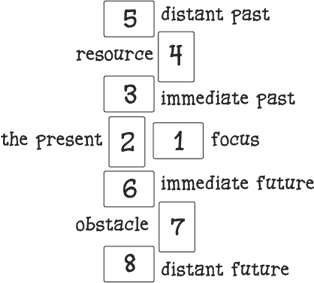
Here’s an example of a cartomancy spread:
A reader places a card on every rectangle pictured above. They would then apply the meaning of the card to the situation it stands for. A spread sets up the situation you are looking to divine about. Here is a spread focusing on a person’s whole life but a reader could lay out a spread that’s centered on a person’s love, job opportunities, or present struggles.
Cartomancy tips
If doing a face-to-face reading, it’s a good idea to ask the receiver to shuffle the cards. This allows them to connect to the cards and engage in the reading.
When you draw the cards, you can choose from the top of the deck or spread them out and choose whichever call to you.
There is more to consider in cartomancy than the set card meanings. A group of certain colored cards can be significant as can a group of court cards (kings, queens, jacks)
The more you know about the cards, the easier readings become.
A shapeshifter typically refers to a person who puts on the body of an animal, although it can sometimes be a human, through magic. The term can also technically refer to animals who turn into humans, such as the Irish selkie and the Japanese kitsune, although we’ll only be discussing human transformation here. Warning: Really fucking long post ahead.
[Image description: German woodcut of a werewolf, half transformed.] [Image Source]
Witches were often said to transform into cats or hares, but mice, deer and even birds such as ravens or owls were also common. One telltale sign that the animal was a transformed witch was that it would be entirely black or entirely white, as in this tale about a witch called Auntie Greenleaf. Other witches were also said to be able to recognise witches in disguise.
Cats would be chosen because they were a common household animal that would not arouse suspicion. Hares, more so in Britain than in the New World, are associated with witchcraft due to the fact that hares jump and box during mating season, which is said to resemble a coven of witches dancing at a sabbat.
Advantages:
Connecting with nature on a deeper level
Travelling to places you might not otherwise be able to go to
Gaining a better understanding of the animal you shift into
Gaining a new perspective on a problem
Temporarily adopting or building up over time certain qualities associated with a particular animal
It is important to note that in most shapeshifting rituals, an item connected with the animal that the witch wants to shapeshift into is required, such as an animal pelt or feather. For example, folkloric werewolf transformations often involve wearing either a wolf pelt or a 7-tongued belt made of wolf skin, and sometimes also include a salve of wolf fat infused with (most likely trance-inducing) herbs.
If you want a piece of an animal for a shapeshifting ritual, please check the laws in your area first! The ownership of animal parts of many predators, such as wolves and coyotes, and feathers of many kinds of birds, is restricted. Check that these things are legal to own in your area, and if you’re buying, make sure the seller is also acting legally and humanely in their collection of animal parts.
Methods of shapeshifting: familiars
Okay so this is kind of cheating, but one way witches were said to shapeshift was to take advantage of the close bond between themselves and their familiar. The witch would go into a trance state send out their soul (think of it like astral projection) in spirit flight, and lay their consciousness over that of their familiar’s, and possess it. They would then be able to sense everything the animal was sensing, as well as control its movement.
This practice, also known as ‘borrowing’ after Terry Pratchett’s Discworld novels, is described in further detail here.
Methods of shapeshifting: the witch’s fetch
Shapeshifting using the witch’s fetch is a slightly more complex idea that is linked to the ideas of ‘the sidereal body’ and is also kind of comparable with the practice of astral projection.
The ‘sidereal body’ is an idea taken from Eliphas Levi’s ‘Transcendental Magic’, otherwise known as part one of ‘Dogme et Ritual de la Haute Magie’. He also refers to it as the ‘animal soul’ of a person, and the ‘intermediary between the soul and the physical envelope’. Think of the ‘sidereal body’ as a part of your soul that you can project ethereally into the world around you, kind of like an aura. This ‘sidereal body’, this part of your soul, can also detach from your body in sleep and in trance states. In its detached state, the ‘sidereal body’ can be referred to as the witch’s ‘fetch’, or ‘fetch-beast’. Here is a post on a possible ritual for practising raising the fetch.
With the aid of an animal talisman to act as a focus, the witch can mould their sidereal or astral body in two different ways in order to shapeshift:
They can choose not to separate it from the real body, but instead mould it into a kind of magical cloak around themselves, into the shape of the animal they wish to shapeshift into.
Or they can choose to project the sidereal body outwards, and mould the ‘fetch’ into the shape of the animal they wish to shapeshift into. This projection, much like an astral projection, can manifest in the physical realm much like a ghost does.
An example of the witch’s fetch in folklore are the tales in which a witch falls asleep or into a trance state and an observer sees an animal, their fetch-beast, crawl out of their mouth, often a mouse or toad.
Methods of shapeshifting: rituals and charms
In ‘Call of the Horned Piper’, Nigel Jackson gives an example of how a ritual transformation may have been performed. The initiate would undergo a symbolic death, undressing and crossing a lake or a river to symbolise passing to the other side. They would then put on the wolf skin or belt, and perhaps apply a wolf fat salve. In an altered state of consciousness, the initiate’s soul would then ‘be projected forth in the form of a wolf’.
Another means of transformation would be a charm, most famously that recited by Scottish witch Isobel Gowdie. She would say the transformation charm below three times to turn into an animal:
“I sall gae intil a haire,
Wi’ sorrow and sych and meikle care;
And I sall gae in the Devillis name,
Ay quill I come home again.”
And to change back, she would say (once):
“Haire, haire, God send thee caire,
I am in a hairis likness just now,
Bot I sall be in a womanis likenes evin now.”
Less well known are the other charms that Gowdie provided for shapeshifting into a cat and a crow:
“I sall gae intil a catt,
Wi’ sorrow and sych and a black shat;
And I shall gae in the Devillis name,
Ay quill I com hom again.”
“I sall gae intil a craw,
Wi’ sory and sych and a black thraw;
And I shall gae in the Devillis name,
Ay quill I com hom again.”
Isobel Gowdie’s charm was incorporated into a longer charm known as a fath-fith, which stems from ‘deer form’, and was used by hunters, warriors and travellers for stealth.
An example of a possible shapeshifting ritual you can try can be found here. Lizzie of visardistofelphame also writes on how you could create a ritual mask for shapeshifting here.
Warning:
Shapeshifting was often seen as dangerous for the witch: if the possessed animal or projection was harmed, typically by fire or silver, then this damage would be reflected on the body of the witch. For example, if someone kicked the leg of a shapeshifted cat, the witch would have a corresponding leg injury.
Other dangers include not being able to return to your body because you’ve forgotten you were human, have got lost, or travelled too far from your real body. You could also be captured or injured by malevolent spirits while travelling.
This post is already ridiculously long, so sources are under the cut (sorry mobile users)




















 fair--y backup
