A shapeshifter typically refers to a person who puts on the body of an animal, although it can sometimes be a human, through magic. The term can also technically refer to animals who turn into humans, such as the Irish selkie and the Japanese kitsune, although we’ll only be discussing human transformation here. Warning: Really fucking long post ahead.
[Image description: German woodcut of a werewolf, half transformed.] [Image Source]
Witches were often said to transform into cats or hares, but mice, deer and even birds such as ravens or owls were also common. One telltale sign that the animal was a transformed witch was that it would be entirely black or entirely white, as in this tale about a witch called Auntie Greenleaf. Other witches were also said to be able to recognise witches in disguise.
Cats would be chosen because they were a common household animal that would not arouse suspicion. Hares, more so in Britain than in the New World, are associated with witchcraft due to the fact that hares jump and box during mating season, which is said to resemble a coven of witches dancing at a sabbat.
Advantages:
Connecting with nature on a deeper level
Travelling to places you might not otherwise be able to go to
Gaining a better understanding of the animal you shift into
Gaining a new perspective on a problem
Temporarily adopting or building up over time certain qualities associated with a particular animal
It is important to note that in most shapeshifting rituals, an item connected with the animal that the witch wants to shapeshift into is required, such as an animal pelt or feather. For example, folkloric werewolf transformations often involve wearing either a wolf pelt or a 7-tongued belt made of wolf skin, and sometimes also include a salve of wolf fat infused with (most likely trance-inducing) herbs.
If you want a piece of an animal for a shapeshifting ritual, please check the laws in your area first! The ownership of animal parts of many predators, such as wolves and coyotes, and feathers of many kinds of birds, is restricted. Check that these things are legal to own in your area, and if you’re buying, make sure the seller is also acting legally and humanely in their collection of animal parts.
Methods of shapeshifting: familiars
Okay so this is kind of cheating, but one way witches were said to shapeshift was to take advantage of the close bond between themselves and their familiar. The witch would go into a trance state send out their soul (think of it like astral projection) in spirit flight, and lay their consciousness over that of their familiar’s, and possess it. They would then be able to sense everything the animal was sensing, as well as control its movement.
This practice, also known as ‘borrowing’ after Terry Pratchett’s Discworld novels, is described in further detail here.
Methods of shapeshifting: the witch’s fetch
Shapeshifting using the witch’s fetch is a slightly more complex idea that is linked to the ideas of ‘the sidereal body’ and is also kind of comparable with the practice of astral projection.
The ‘sidereal body’ is an idea taken from Eliphas Levi’s ‘Transcendental Magic’, otherwise known as part one of ‘Dogme et Ritual de la Haute Magie’. He also refers to it as the ‘animal soul’ of a person, and the ‘intermediary between the soul and the physical envelope’. Think of the ‘sidereal body’ as a part of your soul that you can project ethereally into the world around you, kind of like an aura. This ‘sidereal body’, this part of your soul, can also detach from your body in sleep and in trance states. In its detached state, the ‘sidereal body’ can be referred to as the witch’s ‘fetch’, or ‘fetch-beast’. Here is a post on a possible ritual for practising raising the fetch.
With the aid of an animal talisman to act as a focus, the witch can mould their sidereal or astral body in two different ways in order to shapeshift:
They can choose not to separate it from the real body, but instead mould it into a kind of magical cloak around themselves, into the shape of the animal they wish to shapeshift into.
Or they can choose to project the sidereal body outwards, and mould the ‘fetch’ into the shape of the animal they wish to shapeshift into. This projection, much like an astral projection, can manifest in the physical realm much like a ghost does.
An example of the witch’s fetch in folklore are the tales in which a witch falls asleep or into a trance state and an observer sees an animal, their fetch-beast, crawl out of their mouth, often a mouse or toad.
Methods of shapeshifting: rituals and charms
In ‘Call of the Horned Piper’, Nigel Jackson gives an example of how a ritual transformation may have been performed. The initiate would undergo a symbolic death, undressing and crossing a lake or a river to symbolise passing to the other side. They would then put on the wolf skin or belt, and perhaps apply a wolf fat salve. In an altered state of consciousness, the initiate’s soul would then ‘be projected forth in the form of a wolf’.
Another means of transformation would be a charm, most famously that recited by Scottish witch Isobel Gowdie. She would say the transformation charm below three times to turn into an animal:
“I sall gae intil a haire,
Wi’ sorrow and sych and meikle care;
And I sall gae in the Devillis name,
Ay quill I come home again.”
And to change back, she would say (once):
“Haire, haire, God send thee caire,
I am in a hairis likness just now,
Bot I sall be in a womanis likenes evin now.”
Less well known are the other charms that Gowdie provided for shapeshifting into a cat and a crow:
“I sall gae intil a catt,
Wi’ sorrow and sych and a black shat;
And I shall gae in the Devillis name,
Ay quill I com hom again.”
“I sall gae intil a craw,
Wi’ sory and sych and a black thraw;
And I shall gae in the Devillis name,
Ay quill I com hom again.”
Isobel Gowdie’s charm was incorporated into a longer charm known as a fath-fith, which stems from ‘deer form’, and was used by hunters, warriors and travellers for stealth.
An example of a possible shapeshifting ritual you can try can be found here. Lizzie of visardistofelphame also writes on how you could create a ritual mask for shapeshifting here.
Warning:
Shapeshifting was often seen as dangerous for the witch: if the possessed animal or projection was harmed, typically by fire or silver, then this damage would be reflected on the body of the witch. For example, if someone kicked the leg of a shapeshifted cat, the witch would have a corresponding leg injury.
Other dangers include not being able to return to your body because you’ve forgotten you were human, have got lost, or travelled too far from your real body. You could also be captured or injured by malevolent spirits while travelling.
This post is already ridiculously long, so sources are under the cut (sorry mobile users)
I get a lot of asks asking about fitness witchcraft; what it is, how to do it, tips, etc. So, here is my consensus of witchy work out tips! I think combining witchcraft and fitness is a wonderful thing to do. It can help you stay motivated, get rid of excess energy, and help create more.
Beginning So, how do you get started? Well, this is pretty much up to you. There’s a lot of ways a fit witch can incorporate witchcraft into their healthy life style. I’ll mostly be discussing the basics of incorporating it into working out, healthy eating, and little tips here and there.
Routine/ritual – You can pretty much turn any routine into a spell ritual. All that energy you exert can be transmuted into the manifestation of your desire. This can work for any routine; your routine at the gym, for yoga, dance, hula hooping, whatever you do to workout there’s usually a routine. Each part of your routine is more or less an ingredient of manifestation. For example; I have a weekly routine, if I manage to do everything in my weekly routine it becomes a catalyst for energy kind of like an exchange of goods – I do this for you and you do this for me. Just like some people do spells in steps, this is similar.
Invoking – If you think thirty minutes on the stair stepper, sweating through every layer of clothing you have won’t invoke Freyja you’re fucking wronggg.
Devotional Work – This kind of ties in with invoking. Whatever way you choose to exercise, you can do it for a deity. For example, when I do weights at the gym it’s often for Freyja or Thor. If it’s for Thor I’ll talk to him while working out and really try to push myself, any new weight that I add or reps are offerings to him and proof of the strength of my love! Or if you have more playful deities you can make a deal, I often make bets with Thor saying if I can add x amount of weight or do it in x amount of time he has to make it storm.
Healthy Eating – Working on being fit and healthy isn’t only about working out, eating what’s good for you matters too. You can use healthy eating as a way of kitchen magic and incorporating the properties of what you eat into your spells. I sometimes use it as devotional work to Eir or as a way of cleansing my body. I don’t mean like a juice cleanse or anything, I just choose foods for the day that have strong cleansing/grounding/purifying qualities.
Weights/Gym/Cardio – I found weights to be particularly grounding and sobering. It’s my go to for days that I really want to manifest a spell or be “put in my place”, sometimes I get so caught up with my anxieties and thoughts that I think they’re much bigger than they really are and I need to be humbled. While these are my personal associations I find weights help with grounding, vitality, self-discovery, intrusive thoughts, discipline, manifestation, good health, strength, perspective, personal growth, and inner radiance. It’s also associated with element earth or water.
Aerial/Pole Dancing/Hula Hooping/Yoga – I use aerial, aerobic, and balance exercises as a way to harvest and release energy. Granted you could do this with literally ANY form of exercise(it’s your practice) I just happen to like the feeling of energy release while these types of workouts. I associate these types of work outs with the elements water and air. I also find they help with emotional healing, creative inspiration, personal magic, spiritual truth, cleansing, release of negativity, inner peace, empathy, endurance, self-healing, and a release of bad habits.
Boxing/Self Defense/Martial Arts – Self-defense and martial arts have been something I’ve recently taken an interest in. I personally have mostly used it as a devotional act and as a way to build myself up. When I say build myeslf up, I mean that in every sense of the term, to be better as witch, to harvest more energy, to be able to harness more energy, to have a better mental and physical resolve, it’s a challenge to myself(although any form of workout can be). I personally tie it to the elements of fire and earth. I associate it with helping gain resolve, patience, strength, spiritual protection, ascension, persistence, activation of mind and will, life force, personal power, magic, vitality, self-loyalty, self-love, and inner radiance.
Archery/Fencing – While I can personally only speak for archery I feel like it ties into introspection and wisdom really well. It’s a good time to focus on yourself, broaden your mind, and focus on silence, solitude. I associate these with the elements water and air. I also associate them with positive self-expression, enhanced communication, intuition, psychic openings, link to the unconscious, regeneration of hope, rejuvenation, self love, heart-centered awareness, manifestation.
Lepidocrocite – element: fire, water; properties: emotional healing, release of self-destructive patterns, love and empathy, soul retrieval, inspiration
Ocean Jasper – element: earth; properties: enjoyment of life, release of negativity and stress, relaxation, positive self-expression, physical and emotional healing
Deity Crystal – This is up to totally up to you! If you’re invoking or devoting your workout to a certain deity you can use whatever crystal reminds you of them.
Intention – Whatever your intention for your work out magic is! If it’s self love or growth rose quartz would be great. Think about what you’re hoping to achieve.
Herbs/Foods These are fruits, veggies, herbs, flowers, etc that I like to use in my fitness witchcraft. You can either include it in a sachet, cook it in a meal, or infuse your water/tea with it! I love bringing fruit/herb infused water to the gym to help keep me motivated.
Rice – element: air; properties: protection, calling on rain, prosperity, hallowing, and abundance
Blueberries – element: water; properties: sense of calm, protection, self-love
Tips
Keep in mind your sweat consists of sodium, sugars, and potassium. Use your own sweat as an ingredient in your magic, your body produces enough of it while working out.
Salt can be used for purification, healing, and protection. Sugar can be used for love, compassion, sweetness in life, and joy. Potassium can be used as an energy amplifier, for strength, will, and healing.
You can draw sigils on your clothing, body, shoes(I love doing the bottom of my tennis shoes so no one else can see it), water bottle, etc. to help keep you motivated and your energy strong! I personally find myself using a lot of runes and staves in my workouts because I feel it ties me closer to my gods. I personally use:
Sowulo for goal setting and success.
Fehu for action and motivation
Uruz for strength and power
Take a crystal with you to the gym! If you’re lucky enough to have pockets you can slip it in there but take into consideration what you’re doing that day. I stuck some citrine in a pocket on my backside once without considering I’d be on my back half the time and ended up with a bad bruise!
Or you can add it to your shoe laces!
Put it in your bra.
Put in your gym bag or yoga mat.
Have some water before you go to stay hydrated! Better yet have some green tea or black tea; both are rich in anti-oxidants and have a small enough amount of caffeine to get you going but won’t make you crash.
Bonus: Crystal charge the water you plan to take to the gym. Double check that your crystal is safe to be used in water first! You could even use moon water for that extra magical boost.
Music! Make a playlist that makes you feel strong and confident. It doesn’t even have to be witchy, just whatever gets your blood pumpin’ and you feelin’ good!
Glamours can be super helpful! Whether it’s something small to have you feeling better about yourself before you go the gym or something to help keep creeps away.
Don’t be to hard on yourself. We’ve all missed a gym day or workout class. It’s not the end of the world, all that matters is that you keep trying. Don’t compare your progress to anyone else other than yourself. It’s okay to go at your own pace.
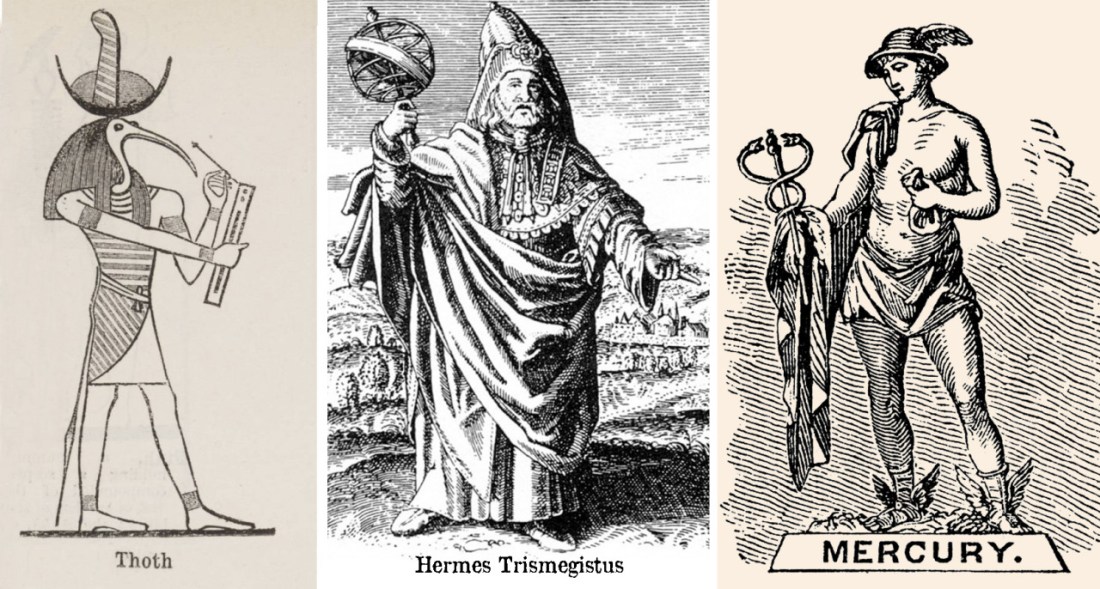
Hermes Trismegistus (Greek for “Hermes the thrice-greatest” or Mercurius ter Maximus in Latin, is the syncretism of the Greek god Hermes and the Egyptian Thoth. In Hellenistic Egypt, the god Hermes was given as epithet the Greek name of Thoth. He has also been identified with Enoch. Other similar syncretized gods include Serapis and Hermanubis.
Hermes Trismegistus might also be explained in Euhemerist fashion as a man who was the son of the god, and in the Kabbalistic tradition that was inherited by the Renaissance, it could be imagined that such a personage had been contemporary with Moses, communicating to a line of adepts a parallel wisdom. A historian, however, would leave such speculation to the history of alchemy and the nineteenth-century history of occultism.
Both Thoth and Hermes were gods of writing and of magic in their respective cultures. Thus the Greek god of interpretive communication was combined with the Egyptian god of wisdom as a patron of astrology and alchemy. In addition, both gods were psychopomps, guiding souls to the afterlife.
The majority of Greeks, and later Romans, did not accept Hermes Trismegistus in the place of Hermes. The two gods remained distinct from one another.
The Hermetic literature added to the Egyptian concerns with conjuring spirits and animating statues that inform the oldest texts, Hellenistic writings of Greco-Babylonian astrology and the newly developed practice of alchemy. In a parallel tradition, Hermetic philosophy rationalized and systematized religious cult practices and offered the adept a method of personal ascension from the constraints of physical being, which has led to confusion of Hermeticism with Gnosticism, which was developing contemporaneously Dan Merkur, “Stages of Ascension in Hermetic Rebirth”.
As a divine fountain of writing, Hermes Trismegistus was credited with tens of thousands of writings of high standing, reputed to be of immense antiquity. Plato’s Timaeus and Critias state that in the temple of Neith at Sais, there were secret halls containing historical records which had been kept for 9,000 years. Clement of Alexandria was under the impression that the Egyptians had forty-two sacred writings by Hermes, encapsulating all the training of Egyptian priests. Siegfried Morenz has suggested (Egyptian Religion) “The reference to Thoth’s authorship…is based on ancient tradition; the figure forty-two probably stems from the number of Egyptian nomes, and thus conveys the notion of completeness.” The Neo-Platonic writers took up Clement’s “forty-two essential texts”.
The so-called “Hermetic literature”, the Hermetica, is a category of papyri containing spells and induction procedures. In the dialogue called the Asclepius (after the Greek god of healing) the art of imprisoning the souls of demons or of angels in statues with the help of herbs, gems and odors, is described, such that the statue could speak and prophesy. In other papyri, there are other recipes for constructing such images and animating them, such as when images are to be fashioned hollow so as to enclose a magic name inscribed on gold leaf.
During the Middle Ages and the Renaissance, the writings attributed to Hermes Trismegistus known as Hermetica enjoyed great credit and were popular among alchemists. The “hermetic tradition” therefore refers to alchemy, magic, astrology and related subjects. The texts are usually distinguished in two categories the “philosophical” and “technical” hermetica. The former deals mainly with issues of philosophy, and the latter with magic, potions and alchemy. Among other things there are spells to magically protect objects, hence the origin of the term “Hermetically sealed”.
The classical scholar Isaac Casaubon in De Rebus sacris et ecclesiaticis exercitiones XVI (1614) showed, by the character of the Greek, the texts that were traditionally written at the dawn of time, to be more recent: most of the “philosophical” Corpus Hermeticum can be dated to around AD 300. However, flaws in this identification were uncovered by the 17th century scholar Ralph Cudworth, who argued that Casaubon’s allegation of forgery could only be applied to three of the seventeen treatises contained within the Corpus Hermeticum. Moreover, Cudworth noted Casaubon’s failure to acknowledge the codification of these treatises as a late formulation of a pre-existing (possibly oral) tradition. According to Cudworth, the text must be viewed as a terminus ad quem and not a quo.
Modern occultists continue to suggest that some of these texts may be of Pharaonic origin, and that “the forty two essential texts” that contained the core work of his religious beliefs and his life philosophy remain hidden away in a secret library.
However, the core idea of Margaret Murray was that all the accused witches were real witches. I say the the exact opposite.
In fact we can say that in *no* trial – included those in which the same defendant turn herself in as a witch in front of inquisitors or judges – we can prove that an accused witch was a real witch.
.: The trials as glimpses of folklore :.
But what we can prove is that the trials – ALL the trials – had the ideas discussed in the courtroom taken from somewhere, right?
Clearly the ideas of the accused witch are qualified as parts of the folklore.
Therefore we have two possibilities for the accused: – or she is an authentic witch (so… no problem, right?) – or she is an innocent person that reports folk legends.
Even the Church, the inquisition, the judges with their trials and their sermons influenced the popular beliefs, and so even if the accused echoed the words and the ideas of the judges, that source (the judges) can still be classified as part of the folklore (either before the trial with the priests’ sermons or after the trial with the bystanders that attended during the delivery of the judgment and then spread the ideas that were spoken).
If we admit that some witch existed outside the trials, we can imagine that there was a sort of heredity in family, with friends, etc. but in order to accomodate the critics, let’s say that no witch ever let in inheritance their tradition.
For the same reason, even if it’s possible that between all those accused witches a real witch could be there,
in order to accomodate the critics, let’s say that no accused witch ever was a real witch.
They were all innocents.
Ok, done. And now? Now what’s left? The folklore of the time. In fact, through the trials we can tap into the folklore of the time. Trials reveal parts of folklore, and therefore trials are a good source for the knowledge of the folklore.
.: The emulation :.
So… witches existed only in folk legends and not really? Even supposing that initially that was the case, there is the phenomenon of emulation. That is, somebody could have taken inspiration from the folklore in order to emulate these beliefs in real life.
Probably the emulation required several steps, for example it is possible that: 1) there was a vast majority of the population who believed in legends about witches; 2) there were certain people who let food offerings to these legends’ characters; 3) there was a minority of people who dreamt these legends; 4) there was an even more restricted minority of people who believed that their dreams about witchcraft meant something and that they were actual witches; 5) there was a minority of minority of minority of people who emulated in physical reality the Sabbath they dreamed.
This idea was put forward by prof. Sabina Magliocco, who writes in her article “Who Was Aradia? The History and Development of a Legend”:
“Ostension is Degh and Vazonyi’s term for the enactment of legends. […] Ostension always derives from a pre-existing legend: the legend precedes the existence of its enactment. […] Hypothetically, legends about spiritual journeys to dance with the fairies and receive healing can easily be transformed by creative individuals into healing rituals with food offerings to the fairies and ecstatic dancing to special music. What if some women, inspired by utopian legends of the Society of Diana/ Herodias, decided to try to replicate such a society in medieval Europe? Though we have no proof such a society ever existed, it is not inconceivable that a few inspired individuals might have decided to dramatize, once or repeatedly, the gatherings described in legends. The use of the term giuoco (“game”) by Sibillia and Pierina suggests the playful, prankish character of ostension. A “game” based on legends of Diana/ Herodias and the fairies would probably have been secret and limited to the friends and associates of the creative instigators, who might well have been folk healers. One or more women might even have played the role of Diana or Herodias, presiding over the gathering and giving advice. Feasting, drinking and dancing might have taken place, and the women may have exchanged advice on matters of healing and divination.”
Furthermore Magliocco specifies that: “However, it is important to
remember that even if a group decided to enact aspects of
the legend of Diana/Herodias, it would not have been a
revival of pre-Christian paganism, but an attempt to act out
certain ritual aspects described in the legends. Moreover, the more magical aspects from the trial reports – night
flights on the backs of animals, ever-replenishing banquets,
resurrection of dead livestock – could not have been achieved
through ostension. We need to consider these as fantastical
legend motifs, reports of experiences from trances or
dreams, or both.”
I, therefore, don’t believe
that the statements of the accused are sources because they were all true witches (Murrayite hypothesis), but they are sources because they record the folklore of the time and so they tell us what possible emulations somebody has or could have carried out.
.: The torture and the discrepancy :.
“But many trials were performed under torture, so they don’t count!”
Even under torture if you were saying things that were in contrast with the expectations of the judges or the inquisitors, then obviously you were not (totally) adapting to their pressures, you were not (totally) reporting (only) their ideas, but also previous elements. So, in order to understand if a confession contained real elements of pre-Christian origin or not, this is the method: if the confession is exactly like what
inquisitors or judges imagined Witchcraft was (i.e. the Devil, the
blasphemy, etc.), the accused was probably repeating what the inquisitors or judges were expecting from her. However, if the story told
during the confession wasn’t aligned with what the inquisitors thought,
it was probably previous to their influences. So, for example, if the judges wanted to know
about the Devil, and then the accused talked about the Fairy Queen
and/or King, or about Madonna Horiente, or about Herodias, or Diana, it wasn’t a simple repetition of the fantasies of the inquisitors or the judges, it was *something else*.
It is in this way that even trials that were performed under torture
count and are valid and useful for rediscovering the names of
pre-Christian Spirits that were still alive in the folklore of the time
and possibly objects of veneration in the emulations of folklore.
This is the method that the famous historian Carlo Ginzburg used. In fact, in we can read from his book “Threads and Traces: True False Fictive” that:
“Between “the image underlying the interrogations of the judges and the actual testimony of the accused,” there was, I explained, a “discrepancy,” a “gap” which “permits us to reach a genuinely popular stratum of beliefs which was later deformed and then expunged by the superimposition of the schema of the educated classes”“.
This gap, this discrepancy, therefore,
allow us to accept even trials in which the torture was used. In those trials we simply look if there was such gap, and we look only at the elements that arise from that discrepancy.
.: Satanic Witchcraft vs Pagan-Animistic Witchcraft :.
However, the fact that we can understand which trials bring pre-Christian elements doesn’t mean that only those trials were emulated, that only the beliefs that arose from those trials were emulated.
All the beliefs had the same probability of being emulated.
Even when the judges or the inquisitors pressured the defendant and the accused slavishly repeated their fantasies, this created folklore. Why? Because after the trial, when the sentence was pronounced before the population, the population assimilated those beliefs.
Thus, as previous ideas led to the emulation of a Pagan-Animistic Witchcraft (Animistic because, as I said in previous posts, former pagan Gods became Spirits in a Christian-dominated society), the new ideas produced by the influence of the Church or the judges led to emulate a Satanic Witchcraft.
Between these two possibilities (Pagan-Animistic Witchcraft and Satanic Witchcraft), we also have a third one: When the accused is using the name of the Devil to hide another being, a pre-Christian or non-Christian Spirit (for example in Basque Country Akerbeltz, the local demon which is at the head of the Sabbath, comes from the Goddess Mari; while in Great Britain the Devil is often the spouse of the Queen of Elphame, therefore is the King of Elphame in disguise).
This last hypothesis, however, does not coincide with the Murrayite idea of an “Horned God”: demonization didn’t happen for a single cult throughout Europe, but could cover practically any pre-Christian Spirit, including female spirits (for example Mari in Basque Country) and not just male spirits.
So, the idea that the Devil is actually a God in disguise and the same God in all Europe is false: he is not a single male horned God that the priests have “mistaken” for the devil, it is the demonization that the priests were working towards *any* non-Christian Spirit. Therefore, to believe that in Spain as in Scotland as in Italy the character that often could be hidden behind the Devil was the same is totally wrong. Whenever the term “Devil” hides a pre-Christian Entity, this Entity is almost always a different one. Therefore we have many Devils for every Nation and region that hide different Gods and Spirit, not a single Devil that hides only one Entity.
However, excluding this third possibility, we can say that there were two kinds of emulators: Animistic-Pagan emulators and Satanist emulators.
The existence of these two types of emulators (although Cohn limits himself to the emulation in dreams) is shown by Norman Cohn in his book “Europe’s Inner Demons”, where he writes:
“It is clear that already in the Middle Ages some women believed themselves to wander about at night on cannibalistic errands, while others believed themselves to wander about, on more benign errands, under the leadership of a supernatural queen. Later, after the great witch-hunt had begun, some women genuinely believed that they attended the sabbat and took part in its demonic orgies: not all the confessions, even at that time, are to be attributed to torture or fear of torture.”
All that we have said so far can therefore make us understand why witch trials are an excellent source for better understanding of both the folklore of the time and the possible emulation of it, even if we admit that almost all of those accused of witchcraft were not really witches.
This is such a huge part of how I practice witchcraft. I’ve touched on it in a bit of my writing, but this does an amazing job of really laying the philosophy out there.
It’s summer! It’s the perfect time to gather flowers, herbs, and whatever else it may be you lovely witches use. This is okay except for the fact where it’s not, I’ve noticed a lot of you literally pick wildflowers, you pop off their heads. That’s not okay, if you don’t properly harvest a plant that’s an annual it may not bud next year, or may not bud again period this summer. How sad would that be? You can’t gain anything from a plant you kill and you owe it the plant to take from it in the least harmful way possible, it is giving you a portion of it’s life. An early disclaimer to avoid conflict, I am a botanist and master gardener and I’m completely qualified to give you this information.
Where To Start
We’re not getting straight into how to harvest, you need to take a minute to consider what you’re doing. Please don’t skip this, it’s important if you give a fuck about the Earth, if you do skip it you’re a dick. Unless you’re picking from your garden(or anywhere that isn’t wild), then you’re fine to skip this.
Are the plants your picking endangered? Have you bothered checking? I’ve seen a lot of witches post on here photos of plants that are going extinct. “Well, it’s just a daisy, there’s plenty of those!” Lakeside daisy are endangered and they’re beautiful, it would be a shame to lose them. There’s over 1,000 types of daisy’s and I can promise you many of them are endangered. Please look it up before you go out picking flowers, leave endangered or threaten species alone.
How do I know if it’s threatened? The majority of the time if you have a parks website you’ll be able to find a page that lists the wildflowers you’ll see on the trail and when they bloom. But what if I can’t find the information? Don’t pick the plant? You wouldn’t shoot an endangered animal, why would a flower be different? Flowers do not adapt like animals do, you can’t just introduce them to a new but similar ecosystem and expect them to exist happily, do not pick it.
Fear not though, there’s other ways to identify plants other than a metro-park website. There are always the information posts on trails and hikes, plus you can buy National Audubon’s Field Guide To Flowers!
Never take more than one-tenth of any given stand of plants, unless what you’re gathering is over growing as an invasive weed. The more you take the less likely it is to lively.
It is best to use gloves when picking and handling cut flowers. All parts of some flowers, such as monkshood, are poisonous and will give you hives and make you itchy, or just make you sick. It’s better to be safe than sorry. See this really helpful poisonous plants page for details
The Best Time To Harvest
For flowers and herbs gather in the morning soon after the sun has evaporated the dew away and before they have sat too long in the hot sun. Herbs and flowers are most potent before budding, and flowers naturally wilt a little when exposed to a hot sun(it doesn’t mean it’s unhealthy it’s just hot).
Most flowers are best picked when they are just starting to show color. Those in full bloom will go over more quickly. However, the flowers of some plants ,such as roses and dahlias, may not fully develop if picked in tight bud.
Roots should either be dug in the fall after the plant has seeded or in early spring just as new growth begins. They should be gathered early in the morning, and before the sun has been overhead too long. If the foliage of the plant has already begun to die, you can gather throughout the day.
Bark should be gathered in early spring, as this is when the sap starts to flow up from the roots, or in the fall, as the sap is returning to the roots. Never strip bark in a circle around a tree, as this will prevent the flow of nutrients from the roots to the branches and kill the tree.
Avoid gathering near roads (at least 50 feet), power lines, areas that may have been exposed to fertilizers, chemicals, pesticides or other insidious forms of chemical pollution. Plants growing around the foundations of old houses, especially those high in minerals, may take up any lead in the soil from old paint jobs.
IF YOU CAN’T CUT FLOWERS IN THE MORNING DO IT IN THE EVENING.
How To Harvest
Let’s be honest, there’s a lot of different ways to gather flowers and some plants need to gathered differently. I do not have the time or effort to list them all so I’m going to list the most common gardening tips.
Please don’t “pick” flowers or just tear them off the stem, you’re leaving them to die. I’ll fight you.
Always use clean, sharp utensils when cutting flowers. Knives, clippers, or shears can be employed. Please don’t ever use ordinary household scissors. The gauge on scissors is set for paper or fabric, not for flower stems, which are bulkier. Using scissors will crush their vascular systems and prevent proper water uptake. I recommend these.
Cut all flowers and foliage about one inch from the bottom of a main stem. Make the slice at an angle of about 45 degrees. Cutting at an angle provides a larger exposed area for the uptake of water.
Woody stems, like roses,
should have an additional vertical cut through the base of the stem to a length of about 2 inches.
Cut the stems to length with a clean, angled cut without leaving jagged edges that could lead to decay. Don’t hesitate when cutting, when you’re comfortable do one quick slice.
Gathering bark is much easier but you can usually find some on the ground if you look around a little bit. Use your knife at the top of a piece of bark and cut horizontally while moving your knife downwards. Trees are hella strong and won’t mind if you cut wrong or a little to deep but still – please be careful!
Who were the Vikings? What were they really like? And what was their world? Fill your horn with mead and take your place by the hearthside, for the night is young and our stories have yet to be sung!
Join me on this History Raid to learn more about the Vikings!



 fair--y backup

