The vizier who settles cases, who changes turmoil to peace, the scribe of the mat who keeps the book, who punishes crime, who accepts the submissive, who is sound of arm, wise among the Ennead, who relates what was forgotten. –from a statue of the Nsw Horemheb 18th D.
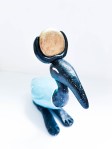
————————————————————————————————— Djehuty is a complex and interesting Name. One I’ve always respected and admired for his knowledge and negotiating powers. He is a balancer, the one who helps to ensure Ma’at. He is in this piece the ibis of wisdom, writing, speech and law, and a perfect addition to any practice or shrine.
You can get a resin cast version of Him on my etsy now!
And please, if there’s a name you want to see me sculpt. A piece from antiquity? I always take suggestions, and will try to fit them all in one by one into my schedule. I love hearing from you all and hope you continue to send messages.
In witchcraft, we sometimes discuss “green wood” and how to harvest it. When I discuss green wood in this post, I am not merely referring to freshly cut wood, but to wood in which a spirit resides. I use this language because I am building off the framework from Pearson’s “Treading the Mill.”
It is entirely possible to request that the spirit of a tree stay within a piece of wood when it is cut. There are two ways to do this. One is to slowly build a relationship with a tree over the course of days, months, perhaps even years. When the time is right, the tree will allow you to cut a piece. The other method is to walk through the forest and find a tree that would be willing to sacrifice itself (or part of itself) for your project. If you have become adept at communing with plants, this should not be particularly challenging.
Here is how I do this. Before I cut the wood, I give the tree a bit of whiskey or something similar. Then I start the process of crafting the tool while the branch is still on the tree. When it is nearly complete, I cut it off. If you do this, be careful to avoid letting it touch the ground. This would make the wood spiritually inert.
The wood must then dry for at least month, possibly much longer if it is a thick piece. When it had dried, it can be carved, sanded, refined, etc. This can be used to make a wand, staff, stang, paten, or a mask. Really the sky’s the limit.
If you are making a wand, you may want to carve out the center and insert something into it. You may include herbs. Which herbs depend on the purpose of the wand. You may also include your own taglocks (hair, fingernails, etc) to bind the wand to you. You can then seal it up with sealing wax.
If you are making a stang, you will want to have it “shod.” I also like to drill a small hole in the fork of the stang so I may place a candle there. A small candleholding implement can be made from floral wire.
The spirit of the wood will reside within the tool for as long as you treat it well. Give it offerings of incense. Clean it as part of your rituals. Put it in a place of honor. You may even wish to feed it with a bit of your blood. This method has never failed me.
I’m actually a little introverted, unless I am around someone I am comfortable with then yes I can be extroverted c: Accurate about the flirty bit. I flirt a lot with everyone.














 fair--y backup